Each year, the University of Melbourne’s Faculty of Business and Economics coordinates several annual public lectures, enabling experts in their field to share knowledge with the community. This is thanks to the generosity of our donors.
The following lectures celebrate the legacies of remarkable individuals, whose work has shaped economics, public policy, and industrial relations in Australia.
Finch Lecture Series (Economics)
Dr David Finch, an esteemed alum of the University of Melbourne, was a pioneering figure in international economics. After graduating in 1944, he earned a doctorate from the London School of Economics under the mentorship of Lionel Robbins, a prominent figure in economic thought.
Finch joined the International Monetary Fund (IMF) in 1950, where he held pivotal roles including as the Director of the Exchange and Trade section. He led the IMF’s consultation mission to the UK during the 1976 sterling crisis, where the UK government borrowed $3.9 billion from the IMF to maintain the value of the GBP.
His insights into international monetary practices and trade integration have left a lasting impact on global economic discourse. The Finch Lecture Series is a tribute to his influence, encouraging ongoing dialogue about the complexities of financial cooperation and economic stability in a globalised world.
Foenander Lecture Series (Management and Marketing)
Dr Orwell D. Foenander was a leading figure in industrial relations scholarship in Australia. He became a lecturer at the University of Melbourne in 1926. By the mid-1950s, he became the first head of an industrial relations department at an Australian university.
His research focused on the federal tribunal system, advocating for its role in addressing social problems and shaping union influence within the workforce.

Throughout his career, he authored numerous influential works that examined the intersection of law, economics, and social justice before retiring in 1969. The Foenander Lecture commemorates his significant contributions to understanding industrial relations.
Freebairn Lecture Series (Public Policy)
Professor John Freebairn, the Ritchie Chair in Economics at the University of Melbourne, has made substantial contributions to economic policy and taxation reform in Australia. With degrees from the University of New England and the University of California, Davis, Professor Freebairn's academic journey has spanned several institutions, including La Trobe University, and Monash University.
Professor Freebairn has collaborated with policymakers at various levels of government to reform taxation systems that balance efficiency, equity, and revenue generation. His extensive research has informed significant reforms, including proposals to replace inefficient state taxes and close loopholes in the income tax system.
The Freebairn Lecture honours his impact on Australian economics and public policy, while serving as a forum for discussion about the future of economic reform in Australia.
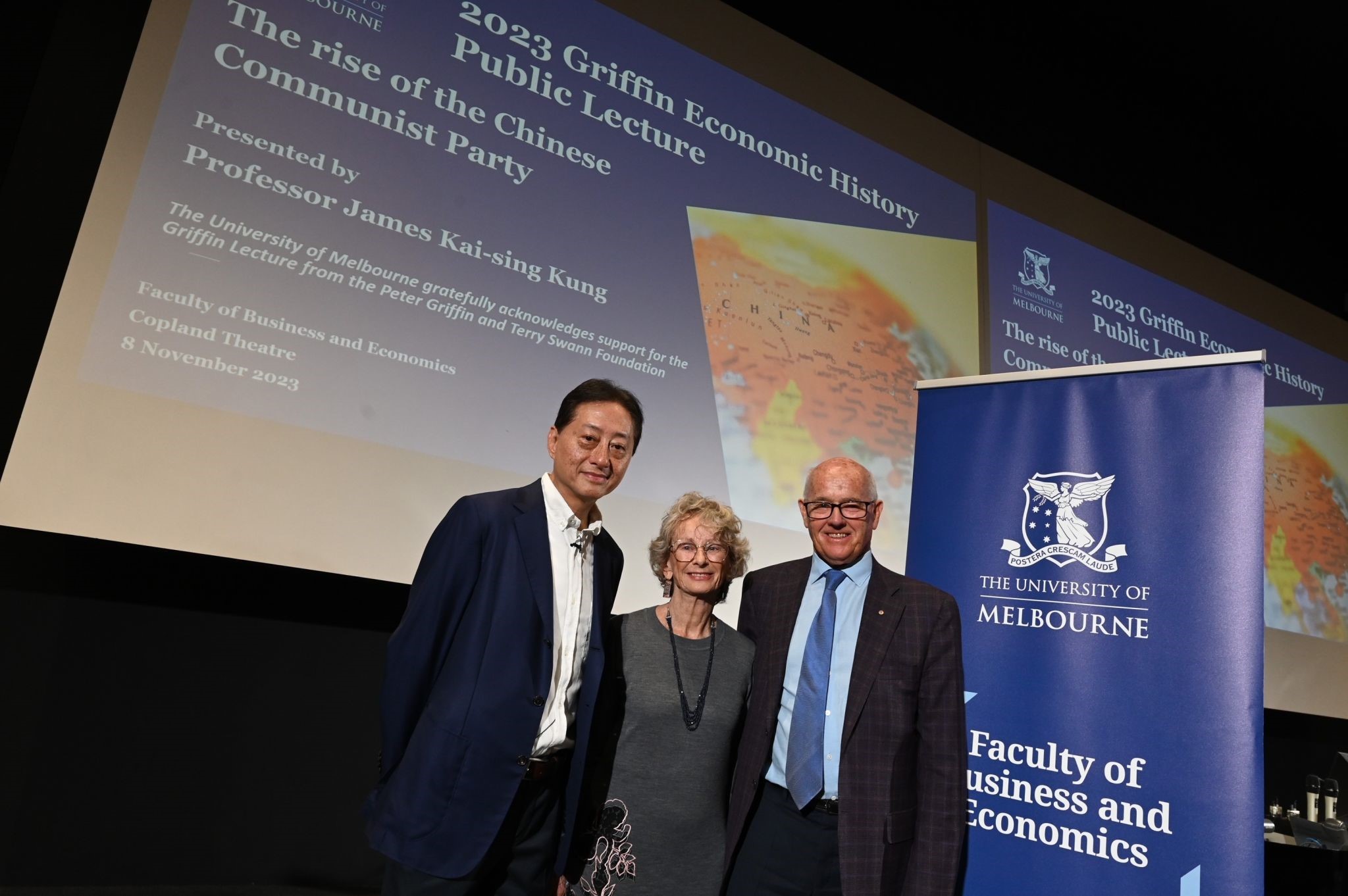
Griffin Economic History Public Lecture (Economics)
Peter Griffin AM, a businessman and philanthropist, has made significant strides in economic history advocacy. An alum of the University of Melbourne, Griffin's long and successful career in business has been complemented by his dedication to supporting medical research and the arts, earning him a Member of the Order of Australia award.
Griffin emphasises the importance of understanding historical mistakes in government and industry to foster a deeper awareness among future leaders. The University of Melbourne gratefully acknowledges support for the Griffin Economic History Public Lecture from the Peter Griffin and Terry Swann Foundation.
In addition, lectures are held to celebrate Max Corden, Joe Isaac and Richard ‘Dick’ Downing.
More stories
-
The history and legacy of the Melbourne Institute
The Melbourne Institute: Applied Economic & Social Research was founded to leverage academic economic research to shape and influence real-world policy.
-
The MONIAC Machine
In a quiet corner of the Giblin Eunson library lies the MONIAC Machine, a relic of economic history and one of only twelve of its kind in the world, representing a unique blend of engineering and economics that has captivated students and scholars since its arrival at the University of Melbourne in 1953.
-
How student support has evolved at FBE
The Faculty of Business and Economics has transformed its approach to student support, shifting to a system that prioritises student well-being, diversity, and employability in response to changing demographics and societal needs.
-
From sandstone to spots: The buildings of FBE
As the Faculty of Business and Economics celebrates its centenary, the evolution of its buildings—from the iconic Old Commerce to the contemporary Spot—reflects its academic growth.