Dick Downing (1915–1975)
BA Hons (1935), Dip Eco Cambridge (1939)
Professor Richard ‘Dick’ Downing, a renowned social reformer and economist, shaped national economic policy debates through decades of impactful work in academia, leaving a lasting legacy in Australia’s economic landscape.
A social reformer and economist, Professor Richard ‘Dick’ Downing was associated with the Faculty of Business and Economics for over 40 years. Downing cultivated national debates on economic policy through his writings and his work with business, government and community organisations. His leadership was revered in the International Labour Organisation (ILO), Australian arts and music sectors, and the ABC.
Learning a role for economists
Finding his way to Economics at the University of Melbourne, Downing studied under Founding Dean Douglas Copland and the Ritchie Chair of Economics, Lyndhurst Giblin, giving him a lasting sense of an economist’s duty to change the world. After graduation, Downing collected and analysed statistics to help him understand problems across the economic disciplines.
In 1937 Downing travelled to Cambridge University, where he completed a Diploma of Economics. On the eve of the Second World War, Downing returned to Melbourne before following Copland to Canberra to support the war effort. The pair entered the public service, often advising the prime minister on economic matters. In Dr Herbert ‘Nugget’ Coombs’s special team, Downing researched the White Paper on Full Employment, which helped set the course for post-war economic policy.
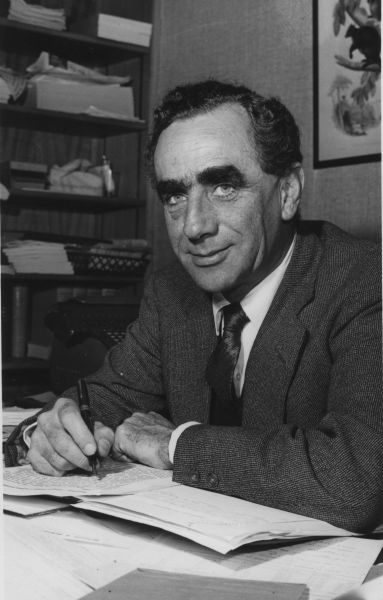
In peacetime, Downing spent time in Geneva and Montreal working for the International Labour Organisation, interspersed with stints at the University and in Canberra overseeing post-war reconstruction. He lectured in public finance, social accounts and statistical method and was involved in a diverse range of international inquiries. He also completed the seminal textbook, National Income and Social Accounts (1951).
Over this time, Downing persuaded Sir George Beeby of the Commonwealth Court of Conciliation and Arbitration to defer a basic wage increase on condition that the federal government introduce a child endowment scheme funded by a payroll tax.
Academic and community leadership
In 1954, Downing was appointed the Ritchie Professor of Economic Research. Considered the pre-eminent academic role in the field at the time, Downing held the position until his death. His policy interests spanned macroeconomics, public finance and social welfare with a side interest in demography.
Downing adapted his mentor Giblin's legacy to fit the post-war years of affluence. His activities spanned research, teaching and administration. He served as the chair of the professorial board (1968–70), assistant vice-chancellor (1969–74) and the editor of Economic Record (1954–73). He also made frequent public comment and advised business and government. While Dean of the Faculty, he often became involved in university budgeting. His central interest lay in promoting social welfare primarily through public policy, whether through the tax system, the reform of pensions, superannuation and medical and hospital benefits, or through public works and services, from transport to education.
Dick was a major contributor to the establishment of the Institute of Applied Economic Research in 1962 and the appointment of Ronald Henderson as the Director.
In 1973, he was appointed chairman of the Australian Broadcasting Corporation (ABC), which allowed him to advocate that issues of diversity and tolerance were to be addressed in the media, often drawing controversy. He also served as chairman of the council for Ormond College, where he had lived as a student.
A legacy
Downing gave innumerable public lectures over decades. He felt the role of the economist was to throw up ideas, test them, assess costs and benefits. He spoke and wrote about this widely across Australia, from conferences to schools, on TV and on radio.
As president (1971–73) of the Academy of the Social Sciences in Australia, he fostered greater coordination and public awareness of research. Downing was a member of the Australian Council for the Arts and served on numerous boards in the field.
Richard Downing died suddenly in 1975 due to blockages in the arteries. The prime minister at the time, Gough Whitlam, paid tribute to Professor Downing: “There was scarcely an area of our intellectual and artistic life that he did not adorn with his wisdom, his experience, and with the singular warmth and force of his personality.”
The Downing Fellowship was established by friends and colleagues at the University of Melbourne to bring distinguished international scholars in social economics to Australia.
More stories
-
Dick Downing (1915–1975)
Professor Richard ‘Dick’ Downing, a renowned social reformer and economist, shaped national economic policy debates through decades of impactful work in academia, leaving a lasting legacy in Australia’s economic landscape.
-
Dato Sri Mustapa Mohamed
Dato Sri Mustapa Mohamed has served as a key Malaysian minister, implementing impactful economic policies, promoting educational reforms, and enhancing Malaysia’s international trade relations, all while championing initiatives that have uplifted rural communities.
-
Helen Hughes (1928–2013)
Celebrated as ‘Australia’s greatest woman economist’ by the Australian Dictionary of Biography, Helen Hughes had a distinguished career in academia and at the World Bank, shaping national policy well into her eighties.
-
Ralph Willis
Ralph Willis's six-decade commitment to the working people of Melbourne and Australia reshaped the nation’s economic landscape.