Max Corden (1927–2023)
AC, BCom Hons (1950), MCom (1953), PhD LSE (1956), DCom (1995)
Max Corden AC left a lasting legacy in academia and economic policy. He tackled major real-world issues, initially focusing on protection and trade policy, then addressing unemployment and inflation.
Max Corden AC, an internationally renowned Australian economist, left an enduring academic and economic policy legacy. Working on the "big economic issues of the day in the real world", he focused on protection and trade policy, and then shifted to unemployment and inflation. Corden recently explored climate change and decarbonisation. With senior academic positions in Australia, the UK and the USA, Corden is best known for his theory of trade protection, but his multiple research interests made him "one of the world’s leading thinkers in international economics". A popular engaging teacher, Corden’s lectures were clear and precise and were characterised by ‘trademark’ diagrams and a friendly demeanour.
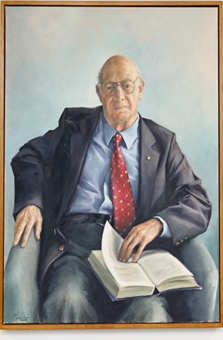
Born Werner Max Cohen, Corden escaped from Breslau with his family in 1939 and arrived in Australia, where they changed their name to Corden.
Gaining scholarships from Melbourne High School for the University of Melbourne and Queens College, Corden graduated with a Bachelor of Commerce (Honours). While working with The Argus newspaper and the Commonwealth Department of National Development, he completed his Master of Commerce, with a thesis on the economics of the newspaper industry.
After completing his PhD in 1956 at the London School of Economics (LSE), he worked for two years at the National Institute in London. Returning to the Faculty of Economics and Commerce, Corden taught international economics, as well as trade and development. His vision provided stimulus for the establishment of a research group which eventually led to the Melbourne Institute. Next, he joined the ANU’s Research School of Pacific Studies in 1962.
Protection and trade
His seminal article about the impact of the tariff structure on industry value was published in the Journal of Political Economy (1966). The voluminous academic literature and international debate led to Corden’s important book, The Theory of Protection (1971).
The case for the Australian Government‘s radical 25-per-cent tariff cut in 1973 was informed by Corden’s work on tariff reform.
In Trade Policy and Economic Welfare (1974, republished in 1997), Corden sets out almost the whole of what is important in economic thinking and international trade.
Appointed as the Nuffield Reader in International Economics at Oxford in 1967, Corden enjoyed being in England again, and nine years in Oxford was the "high point" in his career.
Boom years
Returning to ANU as Professor of Economics, Research School of Pacific and Asian Studies (1977–1988), Corden was also seconded for two years to the International Monetary Fund in Washington DC. His research was devoted to the debt crisis in developing countries.
By 1982, Corden’s interest in booming-sector economics (the so-called ‘Dutch disease’) led to the major paper ‘Booming Sector and De-industrialization in a Small Open Economy’, which was co-authored with Peter Neary and published in The Economic Journal. It is considered a foundational reference on the subject today and is his most widely cited paper.
Corden’s influential writing on macroeconomic dimensions of economic growth and development continued with his appointment as Professor and Chair of the School of Advanced International Studies, John Hopkins University, Washington DC (1988–2002). For 14 years, Corden was a member of the Rockefeller’s Group of 30 Eminent Economists (1982–1996).
Awards and legacies
Awarded Companion of the Order of Australia (AC), the Australian Government’s highest civilian award, Corden was recognised for service as a leading international economist, particularly in the area of international trade and finance policy development. He left a mark on Australian public policy without ever occupying government office because of "the clarity and rigour of his thinking".
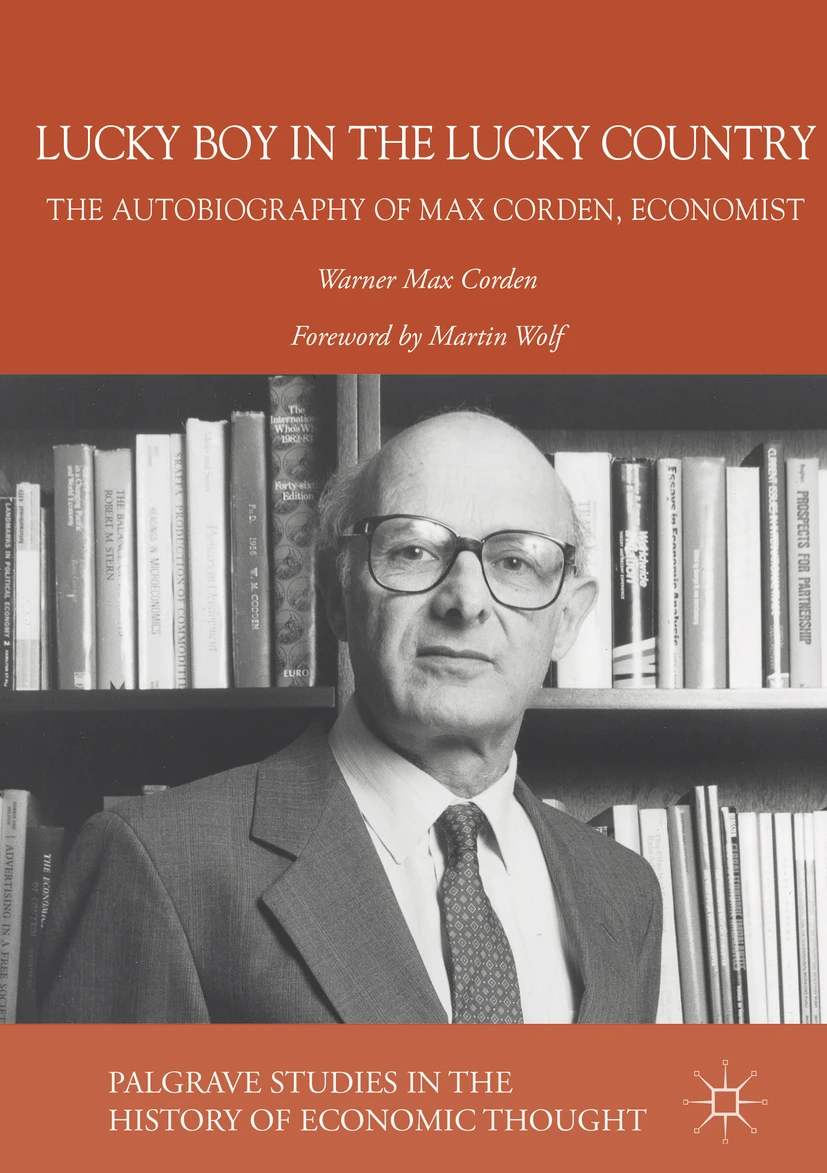
Among the colleagues and students at the universities where Corden held appointments, he has left a lasting legacy. The ANU named the Arndt-Corden Department of Economics in his and Heinz Arndt’s name. The University of Melbourne holds the annual Corden Lecture. Corden’s autobiography, Lucky Boy in a Lucky Country, was published in 2017.
In 2003, Corden returned to the Faculty of Business and Economics as a Professorial Fellow and worked from there into his 90s. Concurrently, he was Emeritus Professor of International Economics at John Hopkins University. In his fifty-year career, Corden held influential academic roles, published a vast output of papers, chapters and books, presented key lectures, and gained local and international honours.
More stories
-
Laura Foo
Laura Foo, the 2023 winner of The Great Australian Bake Off, is a passionate baker whose journey flourished during the pandemic. She's since built a successful brand, LozFoz Bakes.
-
Mary Wooldridge
Mary Wooldridge, head of the Workplace Gender Equality Agency, is on a mission to improve the lives of Australian families, blending her political experience with corporate leadership.
-
Dylan Alcott
Dylan Alcott is a celebrated athlete, entrepreneur, and advocate for disability rights.
-
Blayney Morgan
Blayney Morgan, the third generation of his family to study at the University of Melbourne, has forged a distinct career in auditing and financial leadership.