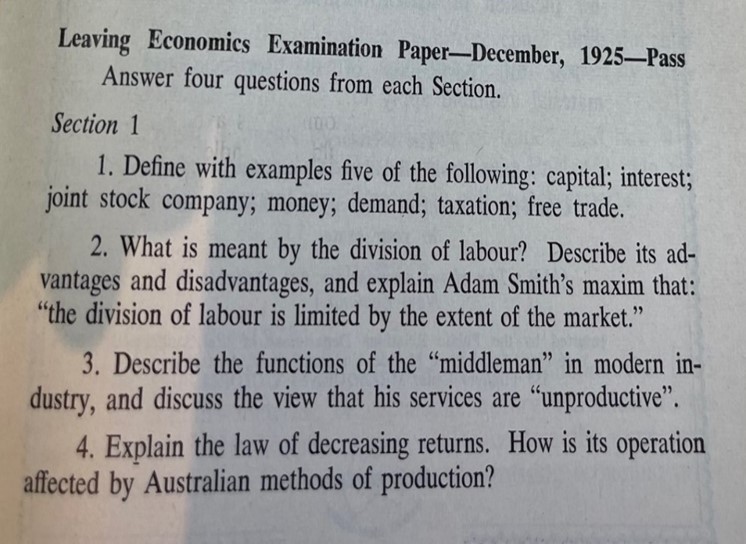
The new Commerce degree was popular with university students. In schools, the number of students studying economics quickly grew. The first economics exam for school leavers was held in 1925. Of the 95 who sat, 38 passed, according to the chief examiner Douglas Copland, Dean of the Commerce Faculty.
Economics in schools
Academics and schoolteachers promoted the teaching and learning of economics. Until Monash University opened in 1961, Victoria’s secondary school economics teachers graduated from Melbourne’s Commerce faculty. One of them, Alan Gregory, referred to the Bachelor of Commerce (BCom) as "a brilliant course".

Victorian Commercial Teachers Association (VCTA)
The Commerce faculty’s Louis Goldberg, chaired the VCTA’s first meeting in 1953, and another faculty leader, Maurie Balson, was an inaugural member. By 1963 it had 700 members. Until the 1970s the VCTA’s leadership were BCom graduates.
Commerce graduate and VCTA member, Frank Nankervis published Descriptive Economics, a popular textbook, in the 1950s. Fellow graduates Neville Drohan and John Day followed up with The Australian Economics Framework, which was inspired by Joe Isaac’s landmark address to the VCTA in 1962. It transformed economics teaching throughout Australia and increased its popularity in schools. Both were popular for decades.
Another popular school text in this era was Commerce’s Richard Downing’s National Income and Social Accounts. He and other Commerce staff lectured to teachers, and included Keith Fearson, John Nieuwenhuysen, Duncan Ironmonger, and Chris Warrell.
Today VCTA has 5000 members and is financially secure due to astute leadership since the beginning.
Universities relinquish control of school curriculum
After 1965, the Victorian Universities and Schools Examinations Board had committees for various school subjects. Its economics committee consisted of Commerce staff plus teachers. It set the course of study, and appointed the exam paper setters and examiners. Later other universities had representatives, and Commerce was no longer in total control. The VCTA continued to take on a significant role in curriculum development.
Since 1979, universities relinquished control of the school curriculum. Various bodies have overseen curriculum and examinations. Since 2000, it’s the Victorian Curriculum and Assessment Authority. Business and Economics is taught from levels 5 to 10 in middle school. In the VCE, all the following subjects are available: Economics, Legal Studies, Business Management, Accounting, and Industry and Enterprise.
Engaging schools, students and teachers
Around the turn of the century, competitive pressures in the tertiary system led to a deepening level of engagement with secondary schools. At the University of Melbourne, the Office for Prospective Students developed a community relations section and a schools liaison unit. Foundation programs create a curriculum that bridges secondary and university studies. Engagement activities include the Access program, and the Kwong Lee Dow Young Scholars Program designed to motivate students at school and connect them with the university. The Schools Outreach Programs includes sheCommerce, an immersive and academic enrichment program delivered by FBE for Year 9–12 students who identify as women or non-binary.
FBE’s ‘Street Finance’ helps secondary students gain a better understanding of everyday money issues.
Trained BCom students teach financial literacy in selected secondary schools.
Since 1953, FBE has liaised with VCTA. It gifts the Copland Room, for the VCTA’s annual ComView Conference with 800 business and economics teachers expected this year. FBE staff provide lectures. As Douglas Copland was the chief examiner for the first secondary school economics exam, it is most appropriate for the economics teachers to meet a century later, in FBE’s conference room, named in his honour.
More stories
-
Pragmatic, convivial and efficient: The history of the Department of Accounting
Accounting at the University of Melbourne has evolved from its modest beginning in 1925, with just 60 students, to a prominent and diverse discipline recognised for its stability, innovation, and significant contributions to the accounting profession.
-
Founding of the Faculty
The University of Melbourne has a rich history in economics education, with roots dating back to 1855 when political economy was part of the Bachelor of Arts curriculum, evolving into the establishment of the Faculty of Commerce in 1924 under the leadership of Founding Dean Sir Douglas Copland, amidst both academic and industry debates about the role of commerce in higher education.
-
FBE Case Competitions
The Bachelor of Commerce Case Competition has become an integral part of the Faculty of Business and Economics' student experience, allowing participants to refine their management consulting and presentation skills while tackling real-world challenges.
-
The founding and legacy of the Economics Department
The Department of Economics, with its profound impact on global institutions and a rich teaching legacy since 1945, has shaped the minds of countless future leaders.