At the recent Bachelor of Commerce Case Competition, where students showcase innovative solutions to real-life challenges, the winning team pitched that they were ready to bring a ‘robot revolution’ to hotels and restaurants across Australia. In 1924, Sir Douglas Copland could not have imagined robots cleaning hotel lobbies, but he did foresee the challenge that the BCom Case Competition looks to address – preparing students for life after their studies.
Case Competitions in the FBE DNA
The BCom Case Competition, along with its international and postgraduate counterparts, offers participants a chance to hone their management consulting and presentation skills.
The Faculty has been involved in these competitions in different forms for more than two decades. Over the years, they have grown to become part of the ‘DNA’ of the core student experience, says FBE Director of Student and Academic Services, Ewan Evans.
Each year, real-world businesses partner with the Faculty, bringing a challenge for students to address in teams, building a ‘case’ they can present in five minutes.
This year, the challenge came from SoftBank Robotics, an industry leader from Japan that designs and sells automated technology for the workplace.
With over 300 students participating, each team of four was tasked with presenting a solution designed to increase the uptake of robots in Australia’s hospitality sector. Throughout the competition, all teams, regardless of their final placement, took part in workshops designed to enhance their consulting and presentation skills.
Programs that reflect the workplace
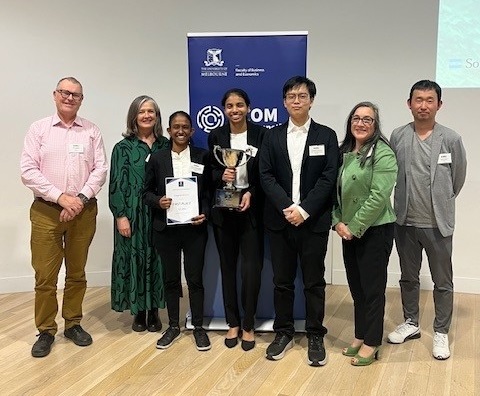
The promised ‘robot revolution’ came courtesy of the competition winners, the Bots Consulting Group.
Isumi Narasinghe, one of the winners, says the key to their success was remaining focused on what the client – or in this case, the judges – wanted.
“We prioritised understanding SoftBank Robotics and its industry, both locally and globally. We recognised Australia's cautious decision making, which was compounded by SoftBank Robotics' limited success stories in the market.”
In the leadup to the presentations, the students were reminded by the judges that the competition is often won in the earliest stages of preparation, as the team comes together and forms their strategies.
Irasinghe felt that working with her teammates Jonathan Utomo, Nathan Doan and Shelina Fernando was the perfect preparation for the workplace later in her career.
“We quickly recognised each other’s strengths and naturally specialised in those areas, while still supporting one another throughout the process,” she said.
I believe this mirrors how teams function in the workplace as well – people tend to specialise in what they do best, but there’s always room for collaboration and offering a helping hand when needed.
Finding a balance
When Sir Douglas Copland established the Faculty and the Bachelor of Commerce, he faced criticism and concern from the Melbourne business community, who were worried the learned professor might rely too much on academic theory and not enough on the practicalities of the commercial world.
The faculty continues to walk this tightrope today, Evans says.
“It’s a tension, that idea between learning for the pursuit of knowledge and for academic success… and then the outcomes of what students want to achieve in launching their careers.”
This mindset has driven the recent addition of over 1500 extra industry experience opportunities, along with the development of many innovation challenges and industry projects to meet students’ demand for authentic employability experiences.
Employability for everyone
Perhaps more poignantly, the Faculty is shifting its focus to recognise that not every student has the same access to career-building opportunities.
A pilot program this year saw the Faculty provide financial assistance to students who couldn’t otherwise afford the travel costs or the time away from work required to do an internship. While this model is in early stages, Evans is optimistic about the opportunities.
In line with this thinking, the Faculty has invested in WorkHub, an on-campus workspace to support a program of project-based industry-led internships with partner institutions. Located on level 6 of The Spot building, the space is designed to replicate an office environment through which students gain valuable real-world experience, enhancing their job readiness.
Like Copland in the 1920s, the Student and Academic Services team, along with the rest of the Faculty, recognise that there is always more work to be done to ensure that students feel prepared for their lives in the future offices, boardrooms and trading floors of Australia.
More stories
-
Dilin Duwa Centre for Indigenous Business Leadership
The Dilin Duwa Centre for Indigenous Business Leadership evolved from the successful MURRA program, created by Professor Ian Williamson and Associate Professor Michelle Evans at the Melbourne Business School, aimed at helping Indigenous Australians excel in business.
-
Founding of the Faculty
The University of Melbourne has a rich history in economics education, with roots dating back to 1855 when political economy was part of the Bachelor of Arts curriculum, evolving into the establishment of the Faculty of Commerce in 1924 under the leadership of Founding Dean Sir Douglas Copland, amidst both academic and industry debates about the role of commerce in higher education.
-
Three decades of the Centre for Actuarial Studies
The Centre for Actuarial Studies at the University of Melbourne has grown from a small program to a leading institution for actuarial education, fostering a strong community and producing influential graduates who shape the discipline both in Australia and globally.
-
Engaging with schools: Students, teachers and FBE
Since the 1950s, FBE has actively engaged with schools and teachers in Victoria, a collaboration that still influences students' learning experiences today.