Universal Design: Making Learning and Teaching More Inclusive
At a glance
One research-informed approach to inclusion is universal design (UD). Within educational settings this means anticipating the diversity of student cohorts to provide equitable and accessible learning experiences.
- Universal design is about inclusion, accessibility, and useability
- Frameworks such as Universal Design for Learning (UDL) and Universal Design for Instruction (UDI) provide strategies for inclusive learning and teaching
- It is commonly understood that universally designed curriculum benefits all students
In depth
What is Universal Design?
Universal design (UD) refers to “the design of products and environments to be useable by all people to the greatest extent possible, without the need for adaptation or specialised design” (CUD, 1997, para. 6). UD has long been recognised as a means for achieving ideals espoused by the social model of disability (Kroeger, & Schuck, 1993), since it shifts the problem of access and equity away from the individual and onto society (Oliver, 1986). This is in keeping with public statements made by universities regarding diversity and inclusion, such as the University of Melbourne’s Diversity and Inclusion Strategy 2030 and the Disability Inclusion Action Plan 2023-2026.
Based on the premise that designers have a responsibility to consider human diversity, it has been argued that UD provides not only access but also non-discriminatory inclusion since it values diversity and equity (Evans et al., 2017). As illustrated below, UD strategies provide a way to conceptualise inclusion, accessibility, and useability as routine rather than as an afterthought should an individual experience difficulty (Burgstahler, 2015).
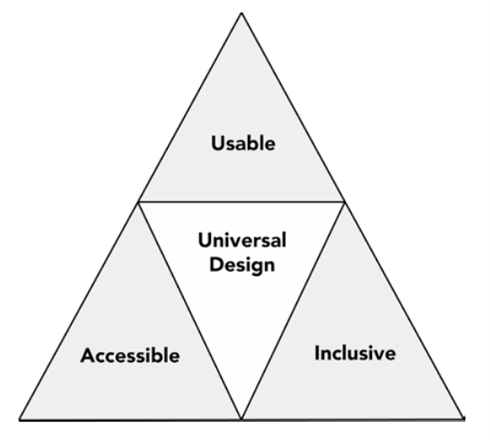
Characteristics of a UD Strategy
From “Accessibility frameworks and models: Exploring the potential for a paradigm shift,” by Burgstahler, S., Havel, A., Seale, J., & Olenik-Shemesh, D. in J. Seale (Ed.). Improving Accessible Digital Practices in Higher Education (p. 48), 2020, Palgrave Pivot, Cham. (https://doi.org/10.1007/978-3-030-37125-8).
Applying Universal Design to Education
When applying UD to education, the needs of a diverse cohort are anticipated. Relevant frameworks include Universal Design for Learning (UDL) (CAST, 2018) and Universal Design for Instruction (UDI) (Scott et al., 2003). While perhaps best described as the inverse of reasonable adjustments (such as those delivered through academic adjustment plans or special consideration), all UD approaches to learning and teaching ask that educators consider the diversity of their student cohort from the beginning of the curriculum design process as well as throughout the delivery of a course and subsequent assessment.
It is a common belief that curricula incorporating UD principles could reduce the need for intervention (such as academic adjustment plans, or special consideration) while benefitting the entire student cohort (Burgstahler, 2015; Ketterlin-Geller & Johnstone, 2006; Mole, 2012). This has been evidenced by academics such as Dean and colleagues (2017), who aligned their teaching of an introductory marketing course to the UDL framework (CAST, 2018), with the intention of addressing diversity. In doing so, they found that their students overall, became more empowered and as a result, assumed greater responsibility for their learning.
Conversations about inclusive learning and teaching have commonly included UD. In fact, Stentiford and Koutsouris found that academics tended to consider inclusive pedagogy and UD as being “one-and-the-same” (2021, p. 2254). This is understandable since UD is also about recognising the needs of both individuals and diverse communities, while being welcoming to all (Norwich, 2013).
UDL and UDI
Within the higher education literature one of three UD frameworks is usually referred to. (Reardon, et al., 2021). Two of these frameworks are labelled “Universal Design for Learning” with the third and less commonly referred to, being “Universal Design for Instruction”. Each highlights ways in which educational resources, pedagogy, flexible curriculum design, and instruction can address student needs while supporting diverse learners (Rao et al., 2014). These UD frameworks acknowledge that some students may learn differently, but they can still achieve academically.
The CAST (2018) UDL framework points to three neurological networks which drive recognition, skills and strategies, and caring and prioritising. It does not advocate for specific teaching practices. Instead, it asks educators to offer multiple means of engagement, representation, and action and expression for their students. Simply put, students should be given choice in terms of “why,” “what,” and “how,” they learn.
In contrast, Rose and Meyer’s (2002) UDL framework contextualised the seven principles of accessible product design (CUD, 1997) for educational settings. As illustrated below, Scott and colleagues (2003) later offered an extended version known as Universal Design for Instruction (UDI). While maintaining the earlier principles of UDL as put forward by Rose and Meyer, Scott and colleagues integrated recommendations from CAST and others. As a result, the UDI framework also asked educators to build a community of learners and to promote a welcoming, inclusive environment (McGuire & Scott, 2006).

Principles of UDL (Rose & Meyer, 2002) and UDI (Scott et al., 2003)
Note. Adapted from “Universal design for instruction - A new paradigm for adult instruction in postsecondary education” by Scott, S., McGuire, J., and Shaw, S. 2003, Remedial and Special Education, 24(6), p.375-376 (https://doi.org/10.1177/07419325030240060801).
Further reading and resources
Burgstahler, S. (2015). Opening doors or slamming them shut? Online learning practices and students with disabilities. Social Inclusion, 3(6), 69-79. https://doi.org/10.17645/si.v3i6.420
CAST (2018). Universal design for learning guidelines V 2.2. https://udlguidelines.cast.org/
Center for Universal Design [CUD]. (1997). The Principles of Universal Design, version 2.0. North Carolina State University website.
Dean, T., Lee-Post, A., & Hapke, H. (2017). Universal design for learning in teaching large lecture classes. Journal of Marketing Education, 39(1), 5-16. http://doi.org/10.1177/0273475316662104
Ketterlin-Geller, L. R., & Johnstone, C. (2006). Accommodations and universal design: Supporting access to assessments in higher education. Journal of Postsecondary
Kroeger, S., & Schuck, J. (1993). Moving ahead: Issues, recommendations, and conclusions. New directions for student services. In S. Kroeger & J. Schuck (Eds.). Responding to Disability Issues in Student Affairs (New Direction for Student Services, no.64. pp. 103-10). Jossey-Bass.
McGuire, J. M., & Scott, S. S. (2006). Universal design for instruction: Extending the universal design paradigm to college instruction. Journal of Postsecondary Education and Disability, 19(2), 124-134.
Mole, H. (2012). A US model for inclusion of disabled students in higher education settings: The social model of disability and Universal Design. Widening Participation and Lifelong Learning, 14(3), 62–86.
Norwich, B. (2013). Addressing tensions and dilemmas in inclusive education: Living with uncertainty. Routledge.
Oliver, M. (1986). Social policy and disability: Some theoretical issues. Disability, Handicap & Society, 1(1), 5-17.
Rao, K., Ok, M. W., & Bryant, B. R. (2014). A review of research on universal design educational models. Remedial and Special Education, 35(3), 153-166. https://doi.org/10.1177/0741932513518980
Reardon, K., Bromley, K. W., & Unruh, D. (2021). The promise of universal design in postsecondary education: A literature review. Journal of Postsecondary Education & Disability, 34(3), 209–221.
Rose, D. H., & Meyer, A. (2002). Teaching every student in the digital age: Universal design for learning. Association for Supervision and Curriculum Development. Alexandria, VA, USA
Scott, S., McGuire, J., & Shaw, S. (2003). Universal design for instruction - A new paradigm for adult instruction in postsecondary education. Remedial and Special Education, 24(6), 369-379. https://doi.org/10.1177/07419325030240060801
Stentiford, L., & Koutsouris, G. (2021). What are inclusive pedagogies in higher education? A systematic scoping review. Studies in Higher Education, 46(11), 2245–2261. https://doi.org/10.1080/03075079.2020.1716322
The Australian Disability Clearinghouse on Education and Training (ADCET) provide guidance and training relating to the implementation of UDL within higher education. Their UDL Plus-One Pledge lists actions educators can take to make learning more inclusive. UDL Plus-One Pledge - ADCET
The UDL Framework (CAST, 2018) is detailed by nine guidelines and 31 corresponding checkpoints for those seeking practical strategies.
The UDL Guidelines (cast.org)
The University College Dublin’s “University for All” initiative is a whole-of-institution approach to inclusion. It draws on UD and UDL (CAST, 2018) to offer high level strategic approaches as well as practical ideas for those teaching.
Pioneering a whole institution approach to inclusion through partnerships and professional development in Universal Design | Advance HE (advance-he.ac.uk)