Getting Started: Models of Blended Learning
At a glance
FBE has two preferred models of blended learning:
- Large undergraduate subjects: 1 + 1 + 1 model
- Graduate subjects: 1 + 2 model
The information below steps you through these models and provides guidance for getting started.
In depth
Models of blended learning
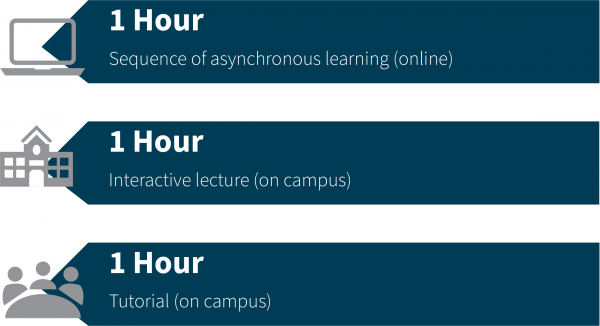
Undergraduate model: 1 + 1 + 1
The 1 + 1 + 1 model refers to a 1-hour (equivalent) sequence of asynchronous learning which may occur before or after the on-campus sessions (to prepare or to summarise and consolidate) plus a 1-hour (50 min) on campus lecture involving interactive elements and a 1-hour tutorial (small group interactive teaching).
 Graduate model: 1 + 2
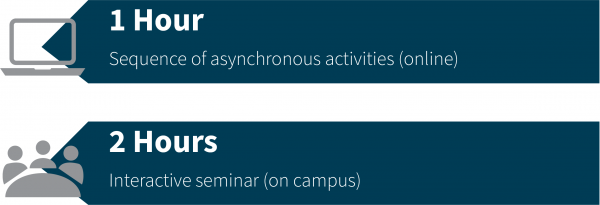
The 1 + 2 model refers to a 1-hour (equivalent) sequence of asynchronous learning which may occur before or after the on-campus session (to prepare or to summarise and consolidate) and a 2-hour interactive workshop/seminar on campus emphasising collaboration, problem-solving, group discussion.
How to best use the online and on-campus spaces for teaching
While the preferred models for UG and Graduate subjects are different, the way you think about the affordances of online spaces and on-campus remain the same.
| ONLINE | ON-CAMPUS |
|---|---|
|
|
Guiding questions for designing blended learning
- What makes sense to be delivered online through the LMS?
- What makes sense to be delivered in person in class?
- How do the online and in-person experiences make sense together?
- What media and technology do you have access to and for what purpose?
- How will the physical space/classroom influence your in-person teaching?
- What videos will be produced and/or curated?
- What online activities and content will be produced and/or curated?
- How will you ensure that students are able to practice crucial domain knowledge in class?
- How will you ensure that online content and activities are meaningful for students?
Basic template for designing an asynchronous online module
See below a basic template to use as a starting point for designing your asynchronous modules.
Introduction Text and 2 min video | Explain the topic and what you expect students to do in the module and why they should do it. |
Subtopic 1 5 to 10 min video and activity | Video explaining subtopic 1 Activity to consolidate learning (e.g., self-check quiz; reading; Padlet, H5P, etc.) |
Subtopic 2 5 to 10 min video and activity | Video explaining subtopic 2 Activity to consolidate learning (e.g., self-check quiz; reading; Padlet, H5P, etc.) |
Subtopic 3 5 to 10 min video and activity | Video explaining subtopic 3 Activity to consolidate learning (e.g., self-check quiz; reading; Padlet, H5P, etc.) |
Summary and quiz | Summary text or video + threshold concepts quiz |
What next? | Video or text explaining the next session in the learning sequence and how students should be prepared for it (e.g., “be prepared to discuss the topics from the online modules with your peers”) |
For more on designing asynchronous online materials for engaging learning see Framework for Designing Meaningful Student Participation Online.
Further reading and resources
Learning design frameworks/models
There are many learning design frameworks which can guide your subject/activity design, including:
R2D2: Read, Reflect, Display, Do
https://www.tandfonline.com/doi/full/10.1080/01587910600789670
ABC Learning design: Acquisition, Collaboration, Discussion, Investigation, Practice, Production
https://abc-ld.org/
Community of Inquiry model
https://operations.du.edu/inclusive-teaching/community-inquiry-model