Group Work Design
At a glance
When designing group work assessment, the following are important to consider:
- Dedicated classroom instruction on group dynamics
- Group size, formation, composition
- Methods of assessment (group, individual, peer)
- Collaboration tools
In depth
Fittipaldi (2020) identified four general considerations for designing a group work assessment:
- Dedicated classroom instruction.
Designing explicit instruction on group collaboration techniques improves group collaboration processes and have a positive effect on performance and learning outcomes. In addition, it helps to align expectations (student-student and student-teacher). As a teacher, it is also important to remain involved throughout the period of the group work.
Examples include:- A series of teambuilding exercises during class time
- 10 minutes of group dynamic instruction in five classes prior to group formation
- Explicit teaching of established frameworks of group collaboration
(e.g., Tuckman’s stages of group development)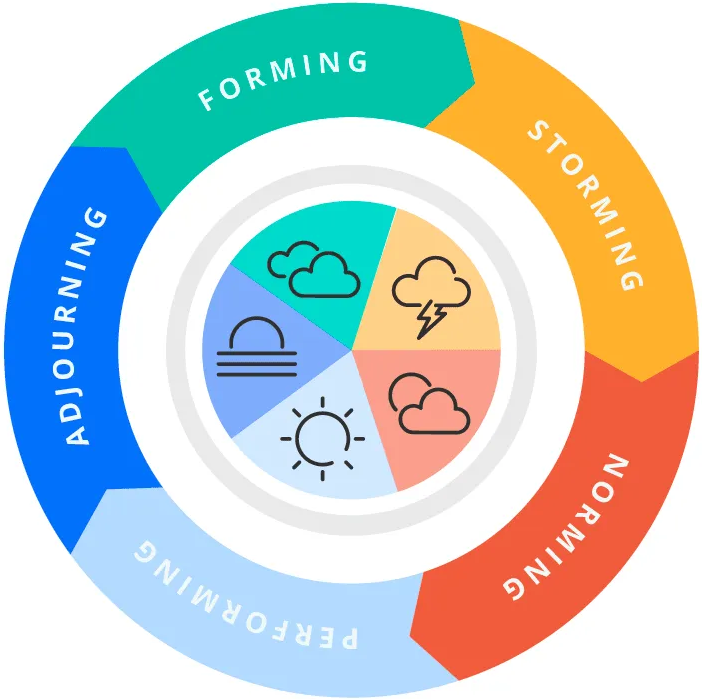 Tucman's revised stages of group development;
image repurposed from TeamHood.com
- Group size, formation and composition. There are two important considerations when thinking about the size, formation and composition of your groups. Firstly, small groups outperform large groups (there are fewer free riders and less conflict). Four-person groups is the optimal size. Secondly, if group members have a mix of strong domain knowledge and project management skills, they will produce higher quality outputs. Interestingly, the way groups are selected (either self-selected or teacher-selected) has no bearing on performance, but does have benefits for smoother group dynamics.
- Assessment. There are many issues related to the assessment of group work assignments. However, peer assessment is known to be essential to group success. When incorporating peer assessment:
- Ensure students are guided through the process;
- Likert-style ratings are best;
- Consider whether you want students to assess each other on domain knowledge and/or collaboration processes and practices.
- Tools of collaboration. Group charters or contracts have been found to enhance student satisfaction and increase performance quality. Informal agreements within groups are less successful than formal agreements, and students should be given explicit instructions on developing their group charter. Other tools that should be encouraged are online project management and sharing platforms such as OneDrive, Groups and Wikis in Canvas and/or any industry-specific digital tools that may be relevant.
Additionally, you can adopt the Group Learning Activities Instructional Design (GLAID) framework when designing group tasks and consider the following:
- Interaction
- Learning objectives and outcomes
- Assessment
- Task characteristics
- Structuring
- Guidance
- Group constellation
- Facilities
Further reading and resources
This resource extensively references Fittipaldi and her systematic review of more than 40 articles about group work. This synthesis will help you reflect on group size, composition and membership, team training, team charters, formative and summative peer assessment and the level of instructor engagement. Similar to Fittipaldi, De Hei et al. thematically reviews group learning activities (GLAs) and proposes the GLAID framework to guide instructors in designinig, implementing and evaluating GLAS. Meijer et al. aim to improve teachers’ and students’ awareness of assessment literacy.
De Hei, M., Strijbos, J-W, Sjoer, E., & Admiraal, W. (2016). Thematic review of approaches to design group learning activities in higher education: The development of a comprehensive framework. Educational Research Review, 18, pp 33-45. http://dx.doi.org/10.1016/j.edurev.2016.01.001
Fittipaldi, D. (2020). Managing the dynamics of group projects in higher education: Best practices suggested by empirical research. Universal Journal of Educational Research, 8(5), pp 1778-1796. https://doi.org/10.13189/ujer.2020.080515
Meijer, H., Hoekstra, R., Brouwer, J., Strijbos, W. (2020). Unfolding collaborative learning assessment literacy: a reflection on current assessment methods in higher education. Assessment & Evaluation in Higher Education, 45(8), pp 1222-1240. https://doi.org/10.1080/02602938.2020.1729696
Tuckman, Bruce W (1965). "Developmental sequence in small groups". Psychological Bulletin. 63 (6): 384–399. doi:10.1037/h0022100