Feedback Resources
At a glance
- “Feedback is one of the most powerful influences on learning and achievement”
- For feedback to be constructive, it must be frequent, timely and personalised
- Providing constructive feedback, at scale, is challenging – consider how alternative assessment methods (particularly self- and peer-assessment) or educational technologies can assist or augment the process.
- Our goal is to develop feedback literacy in our learners, as this contributes to the development of evaluative judgement – an immensely valuable graduate capability
In depth
We refer here to ‘incorporating’ feedback into your assessment, however it should be noted that assessment inherently incorporates feedback, most recognisably in the form of a grade or mark. However, what is being presented here is less concerned with this summative approach, and more focussed on incorporating the more helpful and effective formative feedback.
Why does it matter?
‘Feedback is one of the most powerful influences on learning and achievement’
(Hattie and Timperley, 2007)
From this quote, it would appear that the educational benefits of feedback are conclusive; so why, then, is it still being presented in the literature (and in countless seminars, workshops and conferences) as novel? Perhaps the following quote explains this: “Feedback processes in higher education are commonly misunderstood, difficult to carry out effectively and do not fulfil their aspiration of significantly influencing student learning.” (Boud and Molloy 2013; Evans 2013) In order to correct the misunderstandings surrounding feedback and its significance, some clarification on what is meant by feedback (in the context of assessment) is required.
What is feedback?
Feedback is ‘a process through which learners make sense of information from various sources and use it to enhance their work or learning strategies’. (Henderson, et. al., 2018)
This definition has come from the Feedback for Learning project, a collaboration between researchers and practitioners at the University of Melbourne, Monash University and Deakin University. While it is only one of a long list of definitions available, it contains a number of important terms and phrases that aid interpretation, and open opportunities to interrogate where the misunderstandings come from:
- Process: There is no universal approach for feedback that works in all contexts; a key challenge in feedback is creating feedback processes that effectively uses different sequences, sources, modalities, and so on.
- Learners: This definition focuses on what learners do, specifically ‘making sense of information’
- Sense making: A challenge in feedback design is the conceptualisation of the sense making process. How do we make sense of something? What skills do learners need? What features of the feedback process facilitate effective sense-making?
- Information: What sort of information is most useful for learners? We need to be discerning in what we’re providing or encouraging here.
- Performance: Is a single task sufficient or should feedback focus on the entire assessment process and its composite tasks? How can we have more early feedback opportunities without assessing more?
- Effect/impact: How do we or students know if feedback has an effect? A challenge in feedback design is to set the conditions in which learners have opportunities to demonstrate improvement which is more than simply asking them to do a further task. It necessarily needs to also offer a chance for learners to judge their performance and evaluate it in relation to their changed work/learning strategies.
- Quality: Feedback information needs to be targeted towards improvement, but against what benchmark? Typically, our comments on student work relates to explicit task expectations (e.g. as set out with criteria, in a rubric) however expert understandings of quality are often tacit or hard to describe.
(Feedback for Learning, 2018)
In the context of assessment, the feedback process serves to augment the assessment process by providing opportunities for both teacher and learner to interact and engage more frequently and deeply, to ensure the process of learning is enriched, and progress towards the Learning Outcomes is monitored. Remember, feedback is not unidirectional; engaging in this process will provide valuable assessment of your own teaching practice.
Where is the evidence?
Feedback is critical for effectively promoting learning. Without feedback, learners are limited in how they can make judgements as to their progress, and how they can change their future performance. Feedback is the lynchpin to learners’ effective decision making, and the basis of improved learning outcomes. The value of feedback is tied with its assumed connection to an improved future condition, in other words—impact. (Henderson, 2019)
The final report produced by the Feedback for Learning project team provides data and information gleaned from extensive research directly involving almost 6000 students, educators, academic developers, designers and senior leaders. This study overwhelmingly points to the expectation that the purpose of feedback is improve knowledge and skills or meeting learning outcomes (see Figure 1).
 Figure 1: Percentage breakdown of staff and student perceptions of the purpose of feedback (Henderson, et. al., 2018)
The study seeks to identify what is or is not being done with regards the effective use of feedback for learning, as the following table illustrates: students' level of agreement with various aspects of the feedback comments they received on a recent assessment task.
 Figure 2: Percentage breakdown of students' level of agreement with various aspects of the feedback comments they received on a recent assessment task (Henderson, et. al., 2018)
This is, by and large, a positive reflection of the most important features of feedback, however it is concerning that the neutral or disagreement responses were so high for the question of detail, personalisation and usefulness, with over a quarter of all respondents unable to respond positively to these questions.
Perhaps the most concerning (and relevant) graphic is the next (Figure 3), indicating that 90.8% of students report that academics predominantly provided feedback comments after the submission of their assessment. This is clearly counter to how the research defines effective feedback.
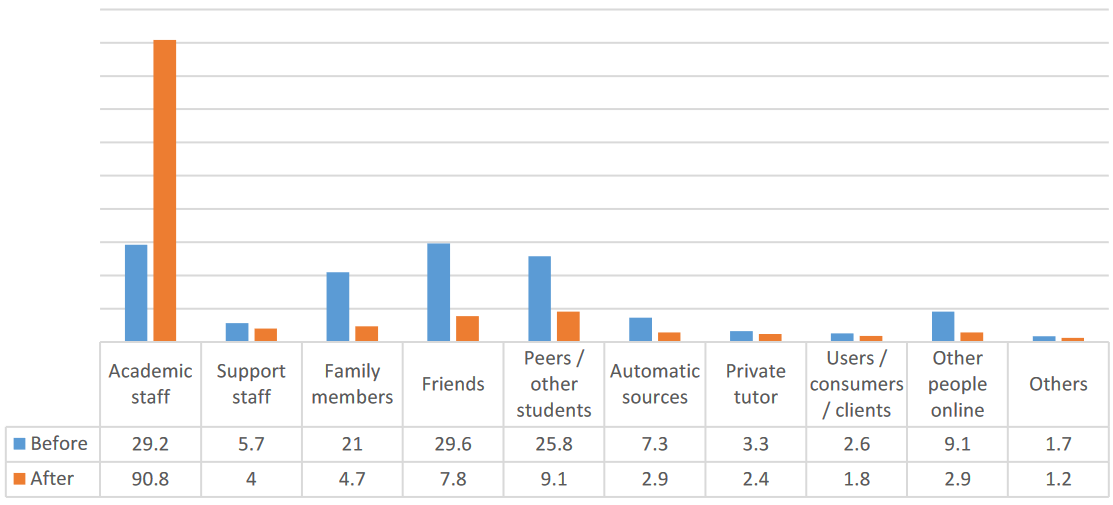
Figure 3: Percentage breakdown of sources of feedback comments before and after submission of assessment tasks, as reported by students (Henderson, et. al., 2018)
How can I make the change and what will it involve?
Mahoney, Boud & Dawson (2018) present nine elements that one can incorporate into curriculum or teaching that will provide students with excellent opportunities to reflect on and respond to as they prepare for their assessment:
- Design follow-on tasks so that learners can apply information received: design tasks in sequences to enable students to check their learning from feedback comments and utilise it in the same unit.
- Move feedback earlier in the unit so learners have time to act: front-end load’ feedback activities early in the trimester so learners can implement suggestions and improve their work.
- Have learners judge their own work against criteria before they submit it: ask learners to appraise their own work before submission to help develop their ability to judge their own progress and engage with criteria and standards.
- Support learners to know what feedback is and how they can make it work for themselves: orientate learners to the role of feedback and expectations of their engagement in these processes.
- Focus on comments for improvement rather than corrections: provide guidance on how learners can usefully improve their future work; for instance, by explaining how they might use these comments in their next task.
- Initiate peer feedback activities that focus on producing improved work: ask learners to evaluate the work of peers to help them engage with standards of work and develop their understanding of what quality work looks like; they also benefit from feedback about their own work.
- Invest time in developing your teaching/marking team: not all staff possess the same understandings and levels of experience in feedback practices. Strategies such as annotated marking guides, team meetings and moderating comments across tutors can help ensure consistency of feedback structure, content and quality.
- Personalise feedback comments to individual learners: focus on unique aspects of their work and plan for students to receive comments from the same educators across a unit: students are more motivated to engage and improve when educators treat them as individuals.
- Consider different modes of providing feedback comments: use different modes such as audio and video recordings, online quizzes and in-class discussions to allow learners to access and make sense of information in different ways
Further reading and resources
Butler Ellis, J., Riley, M. & Toppe Shortridge, R. (2015) Incorporating face-to-face peer feedback in a group project setting, Journal of Accounting Education, 33(4), 317-331.
Carless, D. & Boud, D. (2018) The development of student feedback literacy: enabling uptake of feedback, Assessment & Evaluation in Higher Education, 43(8), 1315-1325
Hattie, J., & Timperley, H. (2007). The Power of Feedback. Review of Educational Research, 77(1), 81–112.
Henderson, M., Boud, D., Molloy, E., Dawson P., Phillips, M., Ryan, T., Mahoney, P. (2018). Feedback for Learning: Closing the Assessment Loop – Final Report. Canberra: Australian Government Department of Education and Training.
Mahoney, P., Boud, D. & Dawson, P. (2018). CRADLE Suggests… Feedback strategies to make a difference. Centre for Research in Assessment and Digital Learning, Deakin University, Melbourne, Australia.
Sotiriadou, P., Logan, D., Daly, A., & Guest, R. (2020). The role of authentic assessment to preserve academic integrity and promote skill development and employability. Studies in Higher Education, 45(11), 2132-2148.
Tai, J., Boud, D., Ajjawi, R., Bearman, M. & Dawson, P. (2019). CRADLE Suggests… Developing evaluative judgement. Centre for Research in Assessment and Digital Learning, Deakin University, Melbourne, Australia