Exam Resources
At a glance
- Exams are neither inherently good or bad, but are often presented as the best way to assess at scale, with academic integrity assured. We would like to contest this thinking.
- There is mounting evidence suggesting that high-stakes exams are neither best practice for evaluating learning outcomes, not provide opportunities for learners to develop skills and capabilities that they will use in their professions.
- We need to differentiate between academic integrity and academic security as this informs who is accountable for what aspect of assessment design.
- Making changes to your assessment architecture can be challenging, but there are ways to make iterative changes in the right direction.
In depth
The debate around exams being ‘good’ or ‘bad’ pedagogy is evident in the articles from The Conversation:
- Why we should abolish the university exam (2011)
- Exams might be stressful, but they improve learning (2014)
- Should we do away with exams altogether? No, but we need to rethink their design and purpose (2016)
The 2016 article presents a view perhaps most useful for our purposes. That is, exams are neither inherently good nor bad; rather, well-designed and appropriately administered exams can be an effective mode of assessment, while others sit on a continuum ranging from not-so-good to completely ineffective.
So where do we start our rethinking or transformation of exam practice? The below figure illustrates the alignment of skills, outcomes and assessment to help guide our thinking.
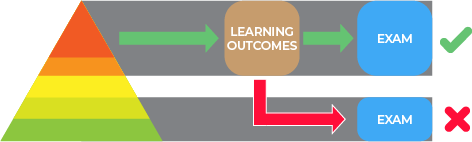
Using a learning taxonomy (in this instance, Bloom’s Revised) you can review the types of skills and capabilities you want your learner to develop. As learners develop, the need to move up this hierarchy of skills and capabilities will be reflected in the subject’s Learning Outcomes (LOs). To assess these, the alignment must continue to ensure that the mode of assessment can do the job. One of the challenges with exams is they can often be misaligned, by assessing lower-order skills (e.g. memorising, listing, repeating or recalling). For an exam to be an effective means of assessment, it must align with higher skill development and the LOs.
Why should we move away from high-stakes exams? Why does it matter?
Having established the importance of exam design, the question of high-stakes exams looms as the next challenge. The growing body of evidence points to the need to move away from high-stakes exams for a number of reasons. To qualify this statement, the paucity of research into the benefits or detriments of high-stakes examinations in Higher Education should be noted. The most relevant research being undertaken is on the validity of entry exams, and the effects they have on secondary school students wishing to enter university; unsurprising considering these are perhaps the most familiar examples of high-stakes examinations.
-
A meta-analysis of research about exams identified self-esteem as having the greatest impact on ‘test anxiety’. A 2018 meta-analytic review of the effects of test anxiety stated that “…self-esteem was a significant and strong predictor of test anxiety [with] perceived difficulty of the test and the high-stakes nature or consequences of the test also related to higher test anxiety [and that] moving away from high-stakes exams will have positive impact when it comes to the mental wellbeing of our students.” (von der Embse, 2018, p. 483) Breaking assessment into smaller, formative components across the semester provides more opportunities for developmental feedback, which will have the dual effect of lessening the potential impact on a student’s self-esteem and diffusing the conditions that might drive cheating.
-
Finally, the anticipation of assessment has a strong influence on what and how learners study, frames what students do, and drives the learning process. This anticipation is known as the ‘backwash effect’ (Villarroel, et al., 2019) assessment has on learning – that is, the type of assessment you set strongly determines the way students study.
Consider this in the context of your students preparing a group report and presentation versus a high-stakes exam – in the former they will be thinking about how to collaborate, what role they will play in the process and what they might collectively achieve. In the latter, students are more likely to second-guess what will be on the exam (or, if provided, simply review previous exams) and study solely for that, rather than develop a more holistic set of skills that will benefit their employability.
-
When considering issues such as contract cheating and assurance of authorship, it is also important to identify the distinction between academic integrity and academic security. Academic integrity is defined by The International Center for Academic Integrity as “a commitment to five fundamental values: honesty, trust, fairness, respect, and responsibility.” (Dawson, 2021) and is more significant in the context of formative assessment, where staged and structured assessment that involves working reflectively and/or collaboratively requires a commitment to such values to be successful.
Academic security is far more important in the context of summative assessment, where the pressure to cheat is greater, and considers a university’s requirement – indeed responsibility - to take reasonable measures to detect e-cheating, develop and implement measures to deter cheating, as well as continue to promote learning with integrity (Dawson, 2021).
Applying this framing, we can see that when dealing with a high-stakes summative assessment the onus is far more on the institution itself to ensure these responsibilities are met, and when dealing with lower-stakes, more regular formative assessment, it becomes more the duty of those operating at the course or subject level to ensure academic integrity is met.
The greater degree of control over the risks of academic integrity breaches can be seen as another reason to move away from high-stakes exams, but on the other hand, this may well be why some are resistant to change. However, despite our responsibility to ensure reasonable measures are taken to detect contract cheating, there is less to be gained from securing well-designed, formative assessment tasks. In fact, overt (or covert) surveillance mechanisms can take up valuable resourcing and can be detrimental to the learning experience. Similarly, “when summative assessment does not meet its summative purpose well enough, there is little point in securing it.” (Dawson, 2021, p. 129) This goes back to the question of whether or not the assessment task is assessing the outcomes appropriately. If not, “security will do little to ensure that the judgements made are valid for their purpose.” (Dawson, 2021, p. 129)
Where’s the evidence?
Consider the following quotes that capture the rationale for making changes to the way we approach examination in Higher Education:
“Test anxiety has continually been demonstrated to have a negative relationship with important educational outcomes across two meta-analyses spanning nearly 70 years of research. The relationship between higher test anxiety and lower test performance has been demonstrated across many hundreds of studies and many thousands of participants.” (von der Embse, et. al., 2018).
“By requiring several lower-stakes assignments, students may not feel the need to perform at an extremely high level for each one. By taking a large exam and breaking into smaller quizzes, the pressure on the student will be less, and this will probably reduce the desire to cheat.” (Wehlberg, 2021)
“Anticipation of assessment has a strong influence on what and how learners study, frames what students do (Boud, 2010), and drives the learning process (Vu & Dall'Alba, 2014). As a result, assessment has been reported as the most effective way to improve of students´ achievement quality (Edström, 2008). When done poorly, it can have the opposite effect.” (Villarroel, et. al., 2018).
How can I make the change and what will it involve?
Here’s some simple takeaways that consolidate the research that informs this guide:
- Focus on the value of what is learned.
Have your assignment created specifically for this course and update the assignment each time. For example, as part of the assignment, have the students reflect on how that concept can apply to their own experiences or how they will use this information in their specific future. - Lower the stakes of any single student assessment or artefact.
By requiring several lower-stakes assignments, students may not feel the need to perform at an extremely high level for each one. By taking a large exam and breaking into smaller quizzes, the pressure on the student will be less, and this will probably reduce the desire to cheat. - Use more narrative or case study type questions rather than single-answer questions.
This requires students to provide more than just the “right” answer and may also increase the likelihood that students will use higher order thinking to provide their responses. For those disciplines that assess quantitative tasks, this might take the form of seeking insight into the process behind arriving at a correct or incorrect answer. Or,
The Faculty of Business and Economics | Assessment Resource Pack Page 18 of 40
alternatively/additionally, describing the professional significance of answering correctly versus the risks associated with answering incorrectly. - Build on prior assignments.
This is an extension on the notion of scaffolded learning. (Murtagh, et al., 2010) If the student work builds progressively over the course of the semester or term, there is little incentive to find ways to cheat. By having assignments that do part of the project and then giving feedback on that to the student before they do the next part, you can build the learning process authentically and individualise the learning process for each student. - Assume that every exam or assignment is open-note or open-book.
- Discuss academic integrity
You can even encourage students to look for information as they are responding to exam questions or in other assignments. This not only encourages higher order thinking skills, such as analysis and synthesis, but it can also cut down on the ways that students will try to cheat because finding new sources is actually part of the assignment.
Make it clear that you will not tolerate cheating in any form. While important to discuss this openly with your students, and to ask them to reflect on the value of doing their own work and learning the material in appropriate ways, it is equally important that you provide clear definitions of what entails integrity and misconduct, as well as the resulting penalties.
Most of the information you will need to have this conversation is available at the University of Melbourne’s Academic Integrity website. If you would like any additional information or support on this topic, particularly questions you might have specific to your subject, please reach out to WCLA via our contact details.
Further reading and resources
Boud, D. & Falchikov, N (eds) (2007) Rethinking assessment in higher education : learning for the longer term. Routledge: London.
Dawson, P. (2020). Defending Assessment Security in a Digital World: Preventing E-Cheating and Supporting Academic Integrity in Higher Education (1st ed.). Routledge: London.
Gamage, K.A.A.; Pradeep, R.G.G.R. & de Silva, E.K. (2022) Rethinking Assessment: The Future of Examinations in Higher Education. Sustainability, 14(6), 3552-3565.
Gardner-Medwin, T. (2022) Implementing Confidence-Based Marking (CBM) with your own Technology. University College London: London. https://www.ucl.ac.uk/lapt/poster2.pdf Accessed June 20, 2022.
Jensen, J., McDaniel, M., & Woodard, S. & Kummer, T. (2014) Teaching to the Test…or Testing to Teach: Exams Requiring Higher Order Thinking Skills Encourage Greater Conceptual Understanding. Educational Psychology Review, 26(2), 307–329.
Murtagh, L., & Webster, M. (2010). Scaffolding teaching, learning and assessment in Higher Education. Teacher Education Advancement Network Journal, 1(2) Online.
Ng C. (2020). Evaluation of academic integrity of online open book assessments implemented in an undergraduate medical radiation science course during COVID-19 pandemic. Journal of Medical Imaging and Radiation Sciences, 51(4), 610–616.
Nsor-Ambala, R. (2020). Impact of Exam Type on Exam Scores, Anxiety, and Knowledge Retention in a Cost and Management Accounting Course. Accounting Education, 29(1), 32–56.
Putwain, DW, Daly, AL, Chamberlain, S & Sadreddini, S (2015) Academically buoyant students are less anxious about and perform better in high-stakes examinations. British Journal of Educational Psychology, 85(3), 247-263.
Simons, J. (2011) Why we should abolish the university exam. The Conversation. 8 July. https://theconversation.com/why-we-should-abolish-the-university-exam-1329 Accessed 27 June 2022.
van Bergen, P. & Lane, R. (2014) Exams might be stressful, but they improve learning. The Conversation. December 19. https://theconversation.com/exams-might-be-stressful-but-they-improve-learning-35614 Accessed 27 June 2022.
Villarroel, V., Boud, D., Bloxham, S., Bruna, D., & Bruna, C. (2020). Using principles of authentic assessment to redesign written examinations and tests. Innovations in Education and Teaching International, 57(1), 38-49.
von der Embse, N., Jester, D., Roy, D., & Post, J. (2018). Test anxiety effects, predictors, and correlates: A 30-year meta-analytic review. Journal of Affective Disorders, 227(1), 483-493.
White, A. (2021) May you live in interesting times: a reflection on academic integrity and accounting assessment during COVID19 and online learning, Accounting Research Journal, 34(3), 304-312.