Over the years, the influence of the Department of Economics has reached as far as the Commonwealth Treasury, the United Nations and the World Bank, but the biggest impact has often been made in lecture halls filled with undergraduate students.
Economics has been taught in one form or another since the University’s inception, but the discipline earned its distinction as the Department of Economics in 1945 with the establishment of the Truby Williams Chair.
A focus on teaching
The responsibility for many of the compulsory subjects within the Bachelor of Commerce (BCom) has rested with the Economics Department for much of the degree’s existence. As such, a lot of the focus of the Faculty has been on the day-to-day teaching of students at every level.

In the earliest days, these students were mostly Australian-born men, studying part time to help improve their business acumen with an understanding of the economic world. This was particularly notable after the Second World War, when returned servicemen like Colin Hamley flocked to the University.
As the years progressed, the ratio of female to male students increased, and the student population became more diverse. With that shift came a growing desire for a more modern approach within the Department.
Professor Wilfred Prest served as Head of the Department for 28 years, and while the leadership was invaluable for the Department’s stability, his departure in the 1970s ushered in a new era, bringing that desired change.
In 1975, the Department established a Chair of Econometrics, appointing Professor Ross Williams. Econometrics was then offered as a first-year subject, and Professor Williams would go on to become an influential and valued member of both the Economics department and the Faculty, spending time in charge of both.
The 1980s saw the arrival of the first overseas students at the faculty. In 1988, there was a grand total of two international students studying a BCom – in 2023, there were almost 700, 35 per cent of the overall student cohort.
Continued change
A general increase in student numbers has meant that for much of the twentieth century, the department had to grapple with relatively high student to staff ratios.
When Associate Professor Jenny Lye started in the Department in the late 1980s, the ‘crowd control’ required to manage a big lecture was one of the most intimidating parts of the job.
Modern-day students, she says, are far more respectful.
Associate Professor Lye credits another big change in the 1990s – the effect of student evaluations. Economics had always been driven by a commitment to the classroom, but this initiative allowed for tutors and lecturers to see how their teaching was viewed by the student body.
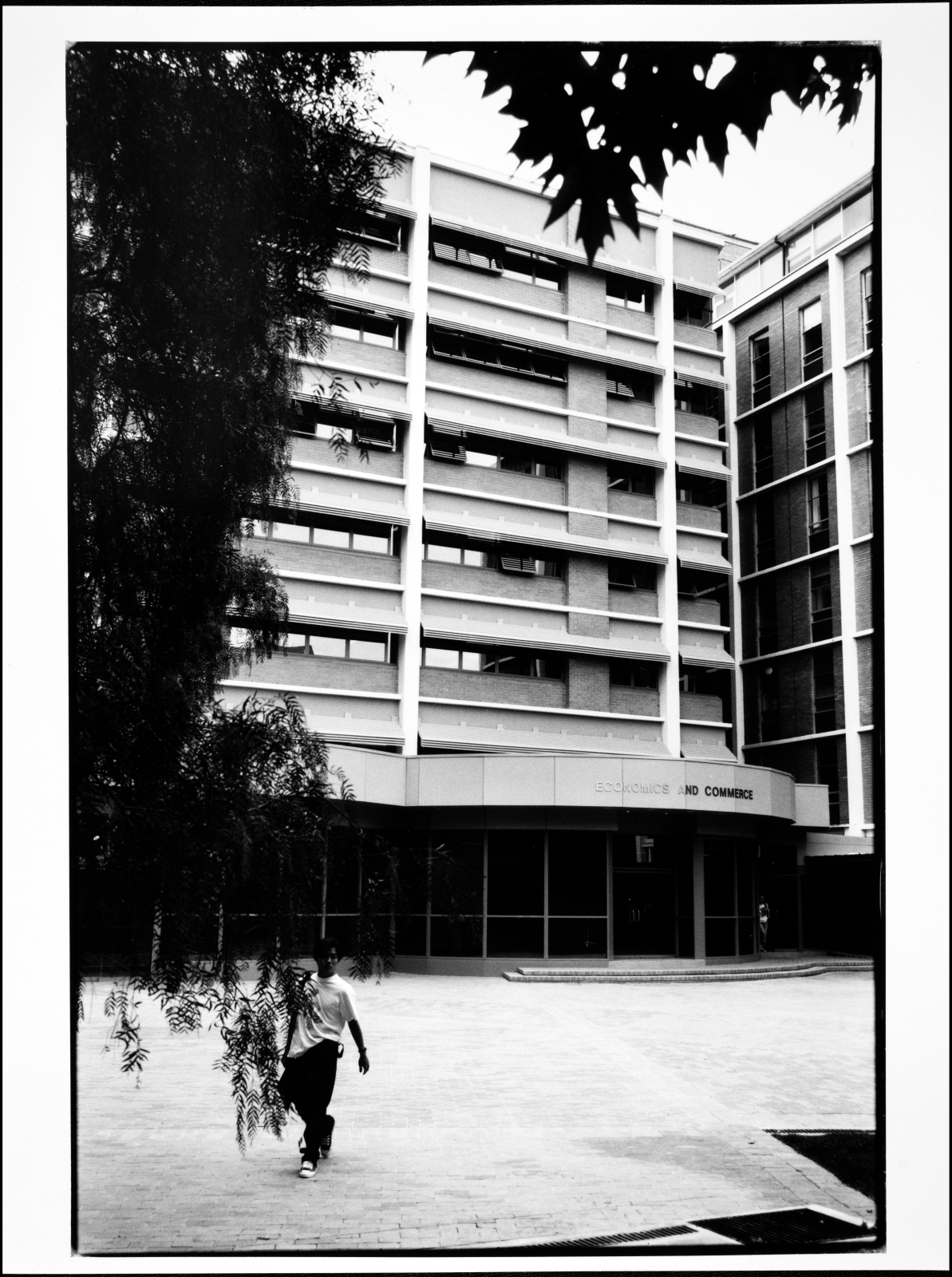
Into the modern day
From the 1980s on, the Faculty looked to diversify the offerings of the Bachelor of Commerce, bringing in extra programs that combined Economics with other disciplines students might need in the workforce. This included the establishment of Actuarial Studies and its Centre, as well as a Finance program that was a precursor to the Finance department.
The advent of new technology also dramatically changed the Economics classroom – the ambient sounds of the crunching punch card machine or the whirring calculators disappeared with the arrival of personal hand-held calculators.
When Associate Professor Lye first arrived at the Department, she was conscious of the gender divide in Economics – she was one of only two full-time women on staff. This too, the professor says, has improved for the better, thanks to an increased proportion of women in the department, as well as greater flexibility for things like family commitments.
Outside of the classroom
When Sir Douglas Copland, one of Australia’s most influential economists, became the founding Dean of the Faculty in 1925, he had recently established what is now known as the Economic Society of Australia. The Economic Society is still influential today, and a number of esteemed Melbourne University economists have served as its president, including Prof Joe Isaac, Prof Max Corden, Peter Karmel, and Danielle Wood. Many others have also contributed to and edited the society’s journal, The Economic Record.
The 1960s saw the founding of the Melbourne Institute: Applied Economic & Social Research, designed to use the Department’s research capability to analyse real-world economics and policy. The Melbourne Institute’s publication, the Australian Economic Review, has also been consistently published since 1968, edited by notable members of the Department. The Institute continues to be one of the great examples of the impact of Economics at Melbourne, and the significance with which it is held is a testament both to its ongoing commitment and the depth of quality research that the broader department achieves.
This continued influence from the Institute, the Economic Society and shifting attitudes towards research have allowed for the department’s research to be a leading contributor to both economic policy and discourse in Australia.
More stories
-
Influence and enrichment: Celebrating FBE contributors
Emeritus Professor Ross William's book 100 Contributors over 100 Years highlights the influential figures who have shaped FBE, showcasing their remarkable contributions to teaching, research, and leadership over the past century.
-
How student support has evolved at FBE
The Faculty of Business and Economics has transformed its approach to student support, shifting to a system that prioritises student well-being, diversity, and employability in response to changing demographics and societal needs.
-
The history and legacy of the Melbourne Institute
The Melbourne Institute: Applied Economic & Social Research was founded to leverage academic economic research to shape and influence real-world policy.
-
Three decades of the Centre for Actuarial Studies
The Centre for Actuarial Studies at the University of Melbourne has grown from a small program to a leading institution for actuarial education, fostering a strong community and producing influential graduates who shape the discipline both in Australia and globally.