The University of Melbourne has a rich history in economics education, with roots dating back to 1855 when political economy was part of the Bachelor of Arts curriculum, evolving into the establishment of the Faculty of Commerce in 1924 under the leadership of Founding Dean Sir Douglas Copland, amidst both academic and industry debates about the role of commerce in higher education.
After arriving in Melbourne in November 1924 as the founding Chair of Commerce, Sir Douglas Copland asked the Melbourne business community to be patient.
"Wait two or three years before coming to a final decision as to the usefulness of the courses."
He also reminded those in the room that a school of commerce could not be established in a day, and that such a faculty would inevitably make mistakes.
This was an astute prediction. The Faculty of Business and Economics (FBE) has grown over a century, and has at times made mistakes.
Most importantly, reflecting after 100 years, the Faculty is now embedded in the fabric of the Australian business community, and has helped bring useful knowledge to the hundreds of thousands of people who have walked through its doors.

Commerce at Melbourne
It may be a century since the founding of the Faculty, but economics was being taught here long before 1924.
When the University of Melbourne first started classes in 1855, one of the four degrees on offer, the Bachelor of Arts, included the compulsory completion of a one-year survey course in ‘political economy.’
These classes were generally led by William Edward Hearn, an Irish immigrant and well-respected academic, who taught students in both political economy and history.
By the turn of the century, History had been recognised with a Chair of its own, but proposals to establish a similar position in Economics were scuppered by the First World War.
After the war, the University looked to expand its offerings in a range of areas, and sought financial support from the Victorian government and private businesses within Melbourne.
By 1924, enough money had been raised to establish both a chair and a faculty of commerce. A young Douglas Copland, just 29 years old, was appointed as Founding Dean.
Attitudes towards the establishment of such a faculty differed.
On one hand, in the interwar and pre-Depression era, business owners and The Argus newspaper alike had concerns over the ‘bookish’ academic Copland, who had a perceived preference for economic theory rather than the real world of business and commerce.
On the other hand, many academics within the University held concerns that the seemingly more practical field of commerce would undermine the strong academic prestige the University had worked hard to establish.
The Bachelor of Commerce
With the founding of the Faculty in 1924 came the establishment of the Bachelor of Commerce.
Copland envisaged the Commerce degree as offering a “general education in economics, of a reasonable standard."
The degree was not intended to produce professional economists, but rather to equip the average businessperson with both the theoretical and practical knowledge needed to work within the Australian system.
The Student Body
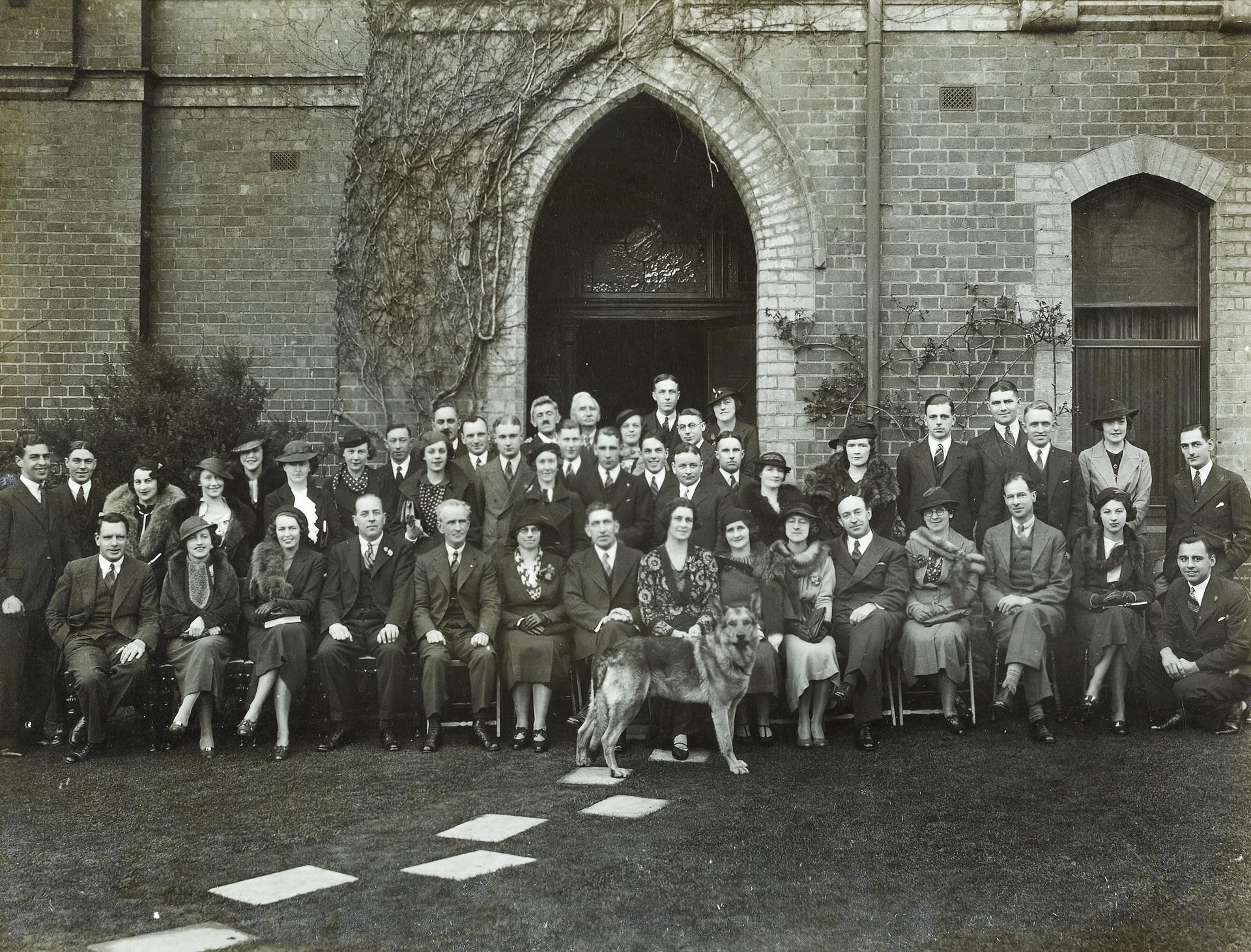
From a student perspective, the Faculty was popular, with 323 students enrolled in the first year – ahead of Sir Copland’s prediction of 250.
Most of the students in this early era were part-time mature male students who had previous experience in accountancy. One such student was AA Fitzgerald, who was part of the first graduating class and would go onto become a major figure in the Faculty as a member of staff.
By 1930, the Faculty’s student population had risen to 530, though numbers declined during the Great Depression and the outbreak of the Second World War. Following the war, however, numbers increased again as those returning from service came to the University in search of a degree, such as Colin Hamley.
Commerce and Arts
Discussions continued after 1925 as to the distinction between the study of business as economic theory and the study of business as a practical tool. Sir Copland felt that it was important to focus not just on teaching good business practice, but also on the broader social science that surrounds the economic world, and that such study fit most practically within the Faculty of Arts.
By 1930, an Honours School of Economics was established, under the control of Sir Copland as the Professor of Commerce but sitting within the Arts faculty. As such, students who wanted to complete an honours degree in any field of commerce had to either study a Bachelor of Arts (Honours), or forgo the Honours element to complete a Bachelor of Commerce. This was not changed until 1946, when an Honours degree was offered in the Faculty of Commerce.
Even after this introduction, many promising economics students continued to study a Bachelor of Arts instead, despite most of their attended subjects being taught by Faculty of Commerce staff, alongside commerce students. In some cases, young women were discouraged from undertaking a Commerce degree, being pressured towards Arts instead by families that subscribed to the narrow-minded thinking of the day that sought to exclude women from the business world.
Departments emerge
After 16 years as founding Dean, Sir Douglas Copland resigned from the Sidney Myer Chair of Commerce in 1940. He was appointed to the newly established Truby Williams Chair, though did not serve in the role for long, resigning to become Australia’s Minister to China. Wilfred Prest, who had been acting in Copland’s role in his absence, was subsequently appointed.
The Ritchie Chair, sitting within the Faculty of Arts and dedicated to economic research, was also moved to the Faculty of Economics and Commerce. This prompted a new approach to the division of the faculty – with departments in commerce, economics, economic history and economic research.
More stories
-
FBE and World War II
During World War II, the Faculty of Business and Economics faced significant disruptions, adapting to the demands of the war while navigating limited resources and a transformed campus environment.
-
HILDA: Understanding Australian families for more than 20 years
For over 20 years, the HILDA survey has uniquely captured the dynamics of Australian families by annually engaging with approximately 16,000 individuals to provide invaluable insights into their lives, work, and spending habits, making it the country's premier source of longitudinal data on household income and labor dynamics.
-
Dilin Duwa Centre for Indigenous Business Leadership
The Dilin Duwa Centre for Indigenous Business Leadership evolved from the successful MURRA program, created by Professor Ian Williamson and Associate Professor Michelle Evans at the Melbourne Business School, aimed at helping Indigenous Australians excel in business.
-
Indigenous Economic Power Project
In April 2024, the Dilin Duwa Centre for Indigenous Business Leadership, in partnership with Indigenous data custodians and the Australian Bureau of Statistics unveiled groundbreaking findings: Indigenous businesses generate approximately $16 billion in annual revenue.