Mavis Robertson (1930–2015)
AM
Mavis Robertson was a pioneering peace activist, unionist, and architect of the industry superannuation system, whose lifelong commitment to social justice and women’s rights continues to inspire through the Cbus Super Mavis Robertson Scholarship.
One of 50 ‘Great Australians’ honoured by the Australian Human Rights Commission in 1998, Mavis Robertson was recognised for her "contribution to the protection of human rights and services to humanity".
Robertson was an organiser, a peace and disarmament activist, unionist, feminist and pioneer of Australia’s industry superannuation system. Today, the faculty’s Cbus Super Mavis Robertson Scholarship is awarded to Bachelor of Commerce students in her name.
Student, community and political activism
It was Robertson’s high school teachers at Tintern Grammar who suggested that she consider a ‘non-traditional’ line of work. She took it to heart – in the more than 60 years that followed, very few would call either Robertson or her career traditional.
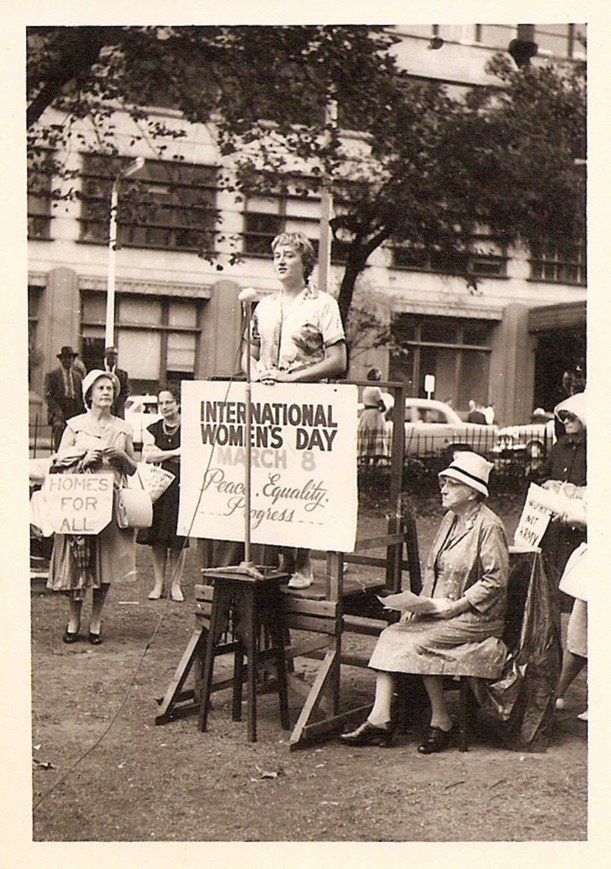
At just 16, Robertson joined the Eureka Youth League (EYL), which was associated with the Australian Communist Party. At the University of Melbourne, Mavis studied Arts and enthusiastically engaged in student life, being elected to the Student Representative Council in 1949. In 1950, she joined others in organising the Australian Peace Council’s Melbourne conference.
Community and Communist Party leadership
Moving to Sydney with an uncompleted degree, she became the EYL’s national secretary in the 1950s. Robertson organised and attended overseas conferences for peace and friendship, pro-democracy and anti-war activities. She also joined collectives that organised International Women’s Day events and women’s refuges. In 1976, Robertson became the first woman named as a national secretary of the Communist Party of Australia. She also established the Nuclear Disarmament Coordinating Committee. In 1984, Robertson left the Communist Party as a skilled organiser, political communicator and networker – skills she had honed since her days as a student.
Superannuation in Australia
For the first 80 years after Australia’s Federation, most people relied on the aged care pension as their primary source of income after retirement. The payment of superannuation contributions was entirely optional for employers, which meant they were only provided to a very few salaried employees who worked for government or large businesses. Multiple inquiries were made into the potential of broader superannuation policies in the early part of the century, but were all met with little enthusiasm. Attitudes started to shift, however, with the election and then dismissal of Gough Whitlam, and more Australians started to consider the benefits of a national scheme.
Making super compulsory
Ready for her next campaign, Robertson returned to Melbourne and threw herself into leading the union’s industry superannuation movement. Robertson could see that the system gave workers little control over the superannuation they were entitled to. Advocating for better rights for blue-collar workers, particularly in the construction industry, Robertson and her union colleagues devised a superannuation model that would help everyone.
“We set out to make it very simple, we said it was like a bank account,” she told Sarah Dowse in 2003.
Employers would contribute 11 dollars a month to each worker’s retirement fund, two of which would go to administration fees and insurance.
Building an enduring legacy
Robertson's work in the sector continued, and in 1984 she oversaw the establishment of Cbus, one of Australia’s largest super funds today. She would go on to serve as a board member and interim chair between 1998 and 2000. In 1991, Robertson founded the first Conference of Major Superannuation Funds. In hosting the conferences annually, she witnessed the lack of representation of women working in the industry.
By 1994, Robertson had established the not-for-profit Women in Super to combat this imbalance. Through Women in Super, Robertson also co-founded the Mother’s Day Classic run and walk in 1998, raising funds for breast cancer research and advocating for women’s health.
Enduring influence
Mavis Robertson died in 2015 aged 84.
The Faculty of Business and Economics and Cbus Super honour her impact with the annual Cbus Super Mavis Robertson Scholarship, which supports female students in financial need to complete their Bachelor of Commerce degree.
More stories
-
Nikki Grinstein
Actuary Nikki Grinstein has turned a lifelong love of learning into a career that continues to benefit society and gets Victorians back to work.
-
Ralph Willis
Ralph Willis's six-decade commitment to the working people of Melbourne and Australia reshaped the nation’s economic landscape.
-
Shaun Moate
Shaun Moate’s extraordinary journey—from a hesitant high school student in Yarra Glen to the Chief Data Officer of TrustPilot—reveals how a hunger for opportunity can transform a life.
-
Harriett Amies (1907–2006), Jean Polglaze (1911–1978), Jean Kerr (1922–2013)
Harriett Amies, Jean Polglaze, and Jean Kerr were trailblazing women in commerce whose influential contributions to business and academia in the twentieth century paved the way for future generations of female leaders.