Colin ‘Col’ Hamley (1922–2021)
OAM, Dip Com (1947), BCom (1951)
A revered former prisoner of war and survivor of the notorious ‘Burma Railway’, Colin ‘Col’ Hamley dedicated his life to community service, helping ex-soldiers and their families. After World War II, he studied at the University of Melbourne supported by the Commonwealth Reconstruction Scheme, which led to a decades-long career in accounting.
Early Life and War Experience
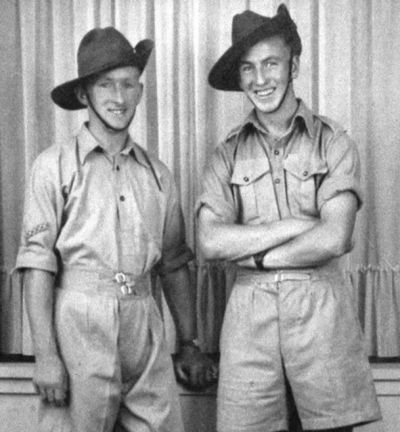
Born in Perth, Hamley moved with his family to Melbourne and left school at 14 to take up a job at the State Electricity Commission (SEC). Eager to support his family during the Depression, he studied at night school, which qualified him for employment benefits, including superannuation. He felt set for life.
At the beginning of World War II in 1939, Hamley planned to enlist, influenced by his father’s experience in the First World War. As the accepted enlistment age was set at 20, Hamley convinced his father to sign a permission form that allowed him to go at just 17.
By 1940, Hamley joined 2/2nd Pioneer Battalion of the Australian Imperial Force and enjoyed training as a Signaller and learning Morse Code. After serving in the Middle East, Hamley’s Battalion arrived in Java in 1942, but was almost immediately taken as Japanese prisoners of war (POWs). During the next three and a half years, he worked in brutal conditions on the Burma–Thailand Railway. Here 11,000 Allied Soldiers, and many thousands of Asian civilians, died as forced labourers.
Hamley suffered malnutrition, malaria, dysentery, and tropical ulcers. During a severe malaria attack, Hamley was kept warm by a lifesaving hand-knitted woollen jumper supplied by the Red Cross.
Returning Home
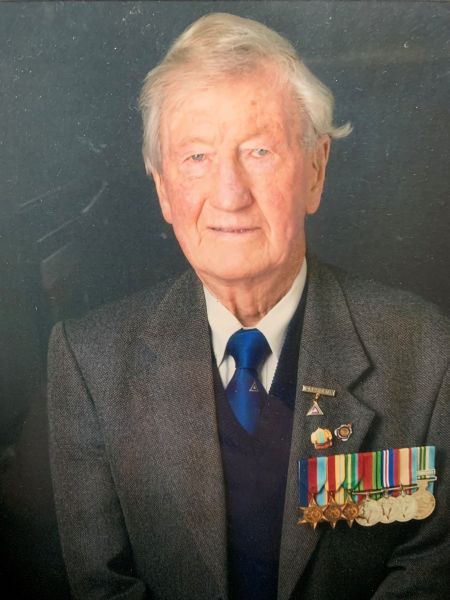
After the Second World War, Hamley returned home to a job at the SEC. Soon, he was interviewed through the Commonwealth Reconstruction Scheme, which had been established to offer vocational or academic training to those who had served. Hamley passed the aptitude test and, after saying he was interested in accountancy, was accepted by the Faculty of Commerce at the University of Melbourne.
In 1946, Hamley was only 24, so not much older than the regular ‘school leaver’ students, whereas most of his counterpart ex-service students were in their 30s and 40s. Having not finished high school, Hamley completed a Diploma of Commerce before graduating with a Bachelor of Commerce. Upon his graduation, he stayed with the SEC as an accountant.
“Our life, when I came back, was getting back into living life and making up for those years that we missed out on,” he told the University of NSW’s Australians at War Film Archive in 2003.
“That’s what made my university course so hard to complete successfully, because I knew I had to earn myself a living, but I knew I also had to catch up on a lot of the living of life.”
A Meaningful Life
While studying, Hamley joined the recently formed 2/2nd Pioneer Battalion Association. Many of his comrades in the Battalion had died as POWs, and he was committed to supporting their families.
His financial and leadership activities with the group continued, including time as its president in 2009. Voluntary work included visitations to hospitalised members, conducting funerals for former comrades, and commemorative services at the annual reunions and overseas pilgrimages. Hamley also successfully encouraged descendants of those who served to keep the association active.
Hamley was a lifetime supporter of the Weary Dunlop Foundation, which was established to commemorate the wartime leadership of POW Sir Edward ‘Weary’ Dunlop and support the health and wellbeing of war veterans. He was also involved in many causes closer to his home in Balwyn, including the Heidelberg Repatriation Hospital and the Ex-Prisoners of War and Relatives Association (Victoria), as well as scout and community groups.
For Hamley, this was the joy of life.
I’ve never felt the need to be wealthy. I felt the need to make life more meaningful, and as far as I can, help people.
“That’s what made me go into the scouting movement, to help the kids and to develop that feeling amongst kids that life is more about living a worthwhile life, than making a fortune.”
With thanks to Col’s son, Don Hamley, who was important in the writing of this piece.
More stories
-
Jenny Louise Macklin
Jenny Macklin was the deputy leader of the Australian Labor Party, where she pioneered social justice changes in Indigenous affairs and disability reform.
-
Katrina Alford
After helping bring change to the university as a student, Katrina Alford built an esteemed career using economics as a way of fighting for what she believes in.
-
Shaun Moate
Shaun Moate’s extraordinary journey—from a hesitant high school student in Yarra Glen to the Chief Data Officer of TrustPilot—reveals how a hunger for opportunity can transform a life.
-
Max Corden (1927–2023)
Max Corden AC left a lasting legacy in academia and economic policy. He tackled major real-world issues, initially focusing on protection and trade policy, then addressing unemployment and inflation.