Interning for impact: Driving Australia’s energy transition with economic insight
By Eliza Chaney
Undertaking an internship with the Department of Climate Change, Energy, Environment and Water (DCCEEW) has been more than a professional learning opportunity; it has been a chance to contribute to meaningful work that is shaping Australia’s clean energy future. It was an honour to gain hands-on experience while completing my studies and to see how my academic background in international business intersects with economic and energy policy.
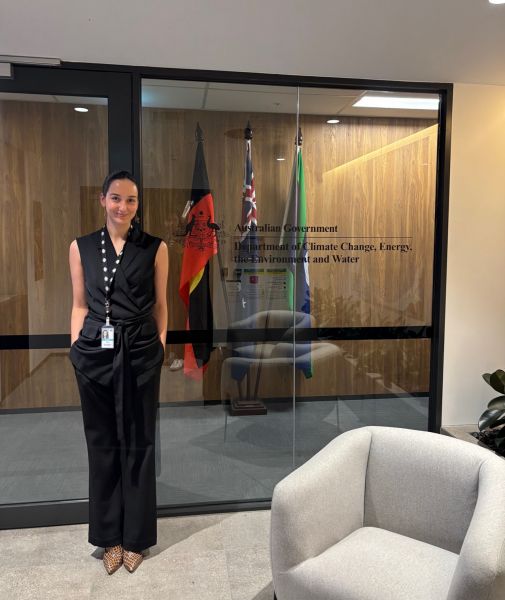
During Semester 2, I completed my internship with the Office of Energy Economics (OEE), part of the National Energy Transformation Division at DCCEEW. The DCCEEW is a leader in Australia’s response to climate change and the transition towards clean energy, and works to protect our environment, heritage, and water resources. The OEE provides evidence-based economic analysis that supports the Australian Government’s efforts towards a clean energy future.
Before beginning this internship, I hoped to gain a deeper understanding of how economic frameworks are applied within the public sector. As part of the Economic Insights team, I worked alongside economists and policy advisers and gained valuable experience in translating theoretical concepts into high-quality economic advice and research that informed the Department’s energy policy work. I also gained first-hand insight into how economic analysis guides policy decisions that influence Australia’s pathway to net zero.
This internship provided me with a real opportunity to apply concepts from my Master of International Business studies, particularly in project management, business and economic analysis, collaboration, finance, and global value chains. The experience also helped me approach tasks through both an economic and strategic lens, deepening my understanding of the broader domestic and international contexts shaping Australia’s energy transition.
Above all, this experience reinforced the value of practical application combined with academic study. It demonstrated how business and economic frameworks inform evidence-based public policy, and how cross-disciplinary collaboration is essential to tackling the complex problems we face in the twenty-first century. It also gave me a strong sense of purpose and confidence in my ability to make meaningful contributions in a professional environment.
I would strongly encourage other Faculty of Business of Economics (FBE) students to seek out internship opportunities through the Business and Economics Internship subject. The opportunity to apply your learning in a real-world setting, while being supported by academic and industry mentors, is invaluable in preparing for the next stage of your career.
Special thanks to FBE for facilitating this incredible experience, and to DCCEEW’s Economic Insights team for their mentorship and opportunity to contribute towards their important work.
Bachelor of Commerce and Melbourne Business School students interested in completing an internship can apply for CMCE20001 Commerce Internship or BUSA90525 Business and Economics Internship. Internships can be self-sourced or through the University of Melbourne.