Congratulations to Anna Nguyen, Idy Zhao, Jamie Wu and Tim Le for their win at the Corvinus Undergraduate Business Experience (CUBE) in Budapest.
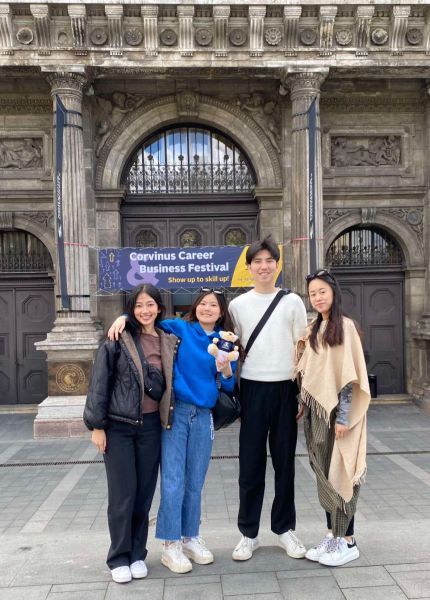
A long-running Faculty of Business and Economics initiative, the International Case Competition (ICC) program trains students in case consulting and sends them overseas to represent the University. This year, the University of Melbourne competed in five global competitions, and I was selected alongside three other students – Anna Nguyen, Idy Zhao and Jamie Wu – for the Corvinus Undergraduate Business Experience (CUBE) in Budapest, Hungary.
The ICC program challenges teams with business problems to solve and present to company executives, senior consultants and academics. It offers students a taste of consulting, and an opportunity to develop skills and business acumen beyond the traditional settings of a classroom. Internationally, case competitions are well-recognised and celebrated, with the world’s leading business schools sending representatives to compete. CUBE was no exception: featuring 16 universities from the USA, Canada, Denmark, Hong Kong and more, the event promised a fierce fight for the trophy.
Despite this being our first international competition, our team was well-rehearsed. The program is supported by an extensive network of ICC alumni, many of whom are now working in leading consulting firms and investment banks. Throughout the summer, we took part in workshops on financial modelling, slide building and presentation, and mock cases that gave us a chance to put our new skills into practice. Equipped with new technical skills, we were ready to take the stage in Hungary. There was added pressure to perform - the University of Melbourne had a three-year win streak in Budapest, so claiming our title for the fourth time would be a rare accomplishment.
While the 25-hour journey from Melbourne to Budapest was tiring, we stepped into Hungary buzzing with excitement and anticipation. Indeed, the next 10 days proceeded better than we could have hoped. Our wonderful team buddy, Milan, was always by our side. Bringing great enthusiasm and knowledge of Hungarian culture, Milan’s friendliness, assistance and impressive e-scooter skills elevated him to an unofficial fifth-team member status. Also guiding us along was our Faculty advisor, Diya. As a past competitor, she brought a wealth of experience, facilitating our feedback and improvement whilst on the ground.
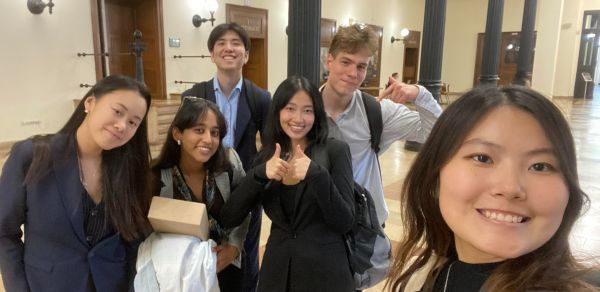
The in-person portion of CUBE comprised of two cases, which we had seven and 24 hours respectively to solve. In the longer case, we were confined to our hotel rooms and tasked with determining how best to penetrate the Hungarian youth market for a global life insurance company, NN Group. Beyond a creative yet grounded strategy, the case demanded an acute awareness of how Hungary’s cultural barriers influenced the youth's adoption of insurance products. Fortunately, the months of preparation beforehand and the week we spent in Budapest immersing ourselves in Hungarian culture enabled us to rise to the challenge.

We won our knockout group stage and proceeded to the finals, where a panel of eight judges - featuring NN Group’s directors, consultants and senior Corvinus University academics - awaited us. Following a lengthy round of questioning (with some particularly tough financial questions), we emerged with the trophy to claim Melbourne’s fourth victory in Budapest.
What elevated our case above the field was the identification of two core challenges underlying all of NN Group’s concerns and practical strategies that targeted them – we encouraged NN Group to provide additional health-related value propositions to Hungarian youth beyond the core life insurance product, as well as the optimisation of their consultation booking processes. Of course, the case-solving period was not without its challenges, especially with mounting pressure and a lack of rest. However, we were able to support each other and work cohesively as a team to push through to the end, with our team chemistry and spirit even being mentioned by several judges.
The cases are only a fraction of the overall case competition experience, and the rest of the week involved Hungarian activities with the other teams. It’s rare to have students from so many different countries gathered in one place and we already have plans to reunite with many of them testament to the bonds forged over the competition. From exploring the ancient architecture of Budapest to wandering down the backstreets and pubs of the old city centre, to biking across the Danube, these social infusions were the undisputed highlights of our trip.
The ICC program is one of, if not, the best program the University has to offer. It blends experience, professional growth, travel and fun into a uniquely rewarding package, not to mention it is funded by the Faculty. Extracurricular activities are an unmissable part of the university experience, and the importance of getting involved in everything the University has to offer cannot be overstated. I strongly encourage everyone to apply for the ICC program, because you never know where that one application might take you. Happy casing!