Facades and foundations: Shaping our marketing mindset
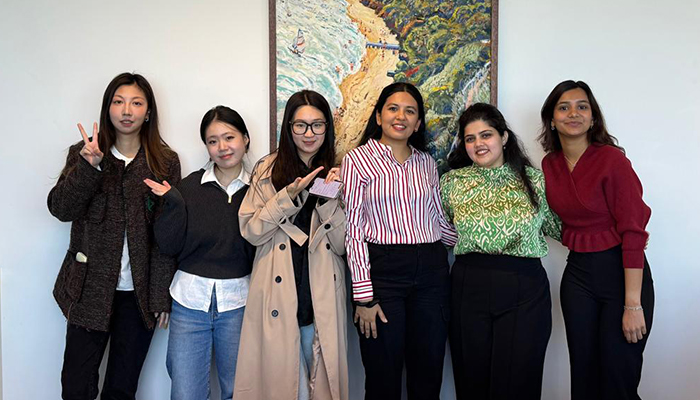
By Rewa Kulkarni, Mingruimeng Huang, Tianqing Huo, Yiran Xiao, Urvi Yatin Shetye and Malavika Prakash
As Master of Marketing Communications students, we had the valuable opportunity to apply our learning in a real-world setting by working with HVG Facades through the Applied Syndicate Project.
We were drawn to the Applied Syndicate Project because it offered a rare opportunity to step beyond our academic learning and deliver marketing solutions for a real client brief. The chance to work with HVG Facades, a leader in the cladding industry and contributor to The Spot building at our university, was exciting and meaningful, as it connected to where we completed our degrees.
Tasked with shaping a digital marketing roadmap, our team conducted research, stakeholder interviews, and client collaboration to gain practical insights into business-to-business strategy and the architectural sector. We were eager to challenge ourselves and see how far our strategic thinking and creative problem-solving could go in a real-world setting.
Working with HVG Facades was an incredibly rewarding experience. Our client representatives, Jessica and Laura, were warm, professional, and committed to our development. Their brief gave us insight into the practical considerations required to shape an effective marketing strategy, including internal alignment, buyer influence, and the importance of building long-term trust with architects and builders. They provided us with clear expectations and constructive feedback, helping us grow with every stage of the project.
One of the most valuable moments came after our interview with Dr. Giorgio Marfella from the Faculty of Architecture, Building and Planning. His feedback helped us see the project through the lens of our target audience: architects. This shift grounded our recommendations in behavioural insight, moving us beyond assumptions and desktop research. This cross-faculty collaboration not only enriched our strategic approach, but also highlighted the value of interdisciplinary research in marketing communications.
As a team, we navigated challenges around time management, group dynamics, and the integration of diverse perspectives. Each member brought unique strengths to the table, ranging from content strategy to design thinking, and it was through this collaboration that our ideas came to life. Our final presentation, the culmination of research, creativity, and teamwork, was incredibly fulfilling, especially seeing our client connect with our vision.
Throughout the project, we were fully supported by our subject coordinator, Professor John Clements. His guidance and trust gave us the confidence to lead the project independently. His support created an environment that encouraged critical thinking and real-world application.
Applied Syndicate Project was more than just a project – it was a transformative experience that deepened our understanding of marketing in practice and helped define our paths as emerging professionals. Through client engagement, cross-cultural teamwork and applied research, we developed skills that extend well beyond the classroom.
We are extremely grateful to the Faculty of Business and Economics and HVG for facilitating this subject and for their immense support in making this a one-of-a-kind learning experience. After completing the project, we feel more confident in our ability to listen, analyse, strategise, and most importantly, contribute meaningfully to the real world – and we’re ready to make an impact.
Are you enrolled in the Master of Marketing Communications? If you're ready to challenge yourself on a project in marketing, communications, media or a related field, you can participate in the Applied Syndicate Project.
Bachelor of Commerce (BCom) and Melbourne Business School (MBS) students can participate in consulting subjects: Management Consulting (BCom) and Business Practicum (MBS).
Are you a business interested in getting involved in industry projects? Please contact us to discuss how we can work together.