Beyond respect: two students leading the way
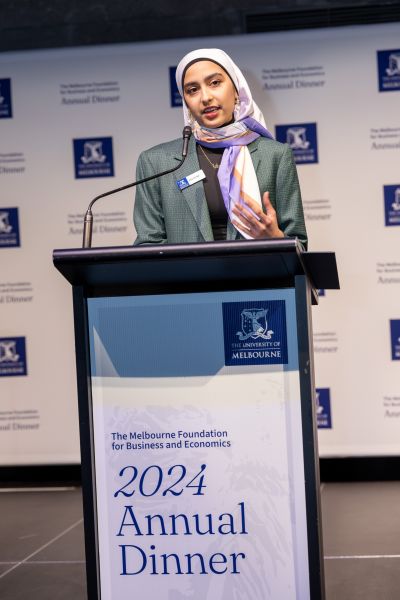
To become a just and sustainable society we need new ideas, concepts and possibilities for action on the table. Two students of the faculty—Sofia Ahmed and Ellie Peppa—talk about how important it is to create an environment in which that can emerge.
In the Faculty of Business and Economics, we want to make a difference. And, in this period of incredible change, it seems more urgent that we, as a society, make the kind of decisions that get us closer to being just and sustainable.
But who gets to make those decisions? What counts as relevant knowledge or information? Who benefits? What, and who is labelled as ‘external’?
A practice of diversity and inclusion is about coming up with better answers to those questions than we did in the past. This faculty needs to put its principles into practice because the students we educate will soon be helping to make decisions that create the future.
We interviewed two students of the faculty, Sofia Ahmed and Ellie Peppa, whose outlook, knowledge and activism make them effective agents of change at this critical time.
Sofia Ahmed
Making visible what is overlooked, by some, is the thread that runs through Sofia’s thoughts on diversity and inclusion. What seems self-evident, or value neutral, to some of us, is most definitely not so, for someone with different experience and knowledge.
For Sofia Ahmed, studying economics in high school was a light bulb moment. She saw at once that it gave her the tools to think about something she observed growing up, which was that even though ‘there was plenty’, some were poor. This, she realised, was the science of how to allocate resources in a way that everyone benefits from, not just one or a few.
As a science, of course, economics needs concepts and theories that explain what is observed and lead to new insights and impact. Is GDP a good proxy of well-being, for example, as is taught in introductory macroeconomics? It observably isn’t, according to Sofia. Is interest the only financial instrument for managing the risks of lending? Islamic finance, practised in Singapore’s dual financial system, is another way, as Sofia observed when she visited on a scholarship.
Now, more than ever, we need new concepts, practices and theoretical tools to think about and address the unsustainability of the ways of life that many Australians, for example, take for granted. Those new ideas and tools will come from people who aren’t beholden to the assumptions and verities of their discipline and who can see through claims about being value-neutral.
That takes effort, from all of us, not only those we seek to include. Sofia said she noticed when she came to Australia, that “we teach respect for others, but it has created an environment of ignorance” where people respect the difference but don’t put that into practice by seeking to learn more. And not just from one person. No individual stands for the beliefs and practices of an entire community.
When asked whether things are going backwards, Sofia answers that “I don’t think we’re going backwards, because we never went forwards.”
For Sofia, the work of change also means remembering “everything I do, I’m not doing it alone. I’m here because others before me took steps that were harder than mine are now.”
Elli Peppa
The trouble with stereotypes—one of them—is that they get in the way of discovering something that you need to know to make good decisions.
Gender stereotypes, for example, and the selection biases that go with them, produce inequality in every part of society—and it has material consequences. Corporations underutilise human capital. Teachers, or a whole education system, presume that girls can’t do maths. Designers of everything from cars to clinical trials don’t even register the existence of a large proportion of the population who, in the end, must make do with goods that are difficult to use or don’t even keep them safe.
These examples from Ellie Peppa all home on a failure to see and hear what women, in particular, can contribute as active agents in the world.
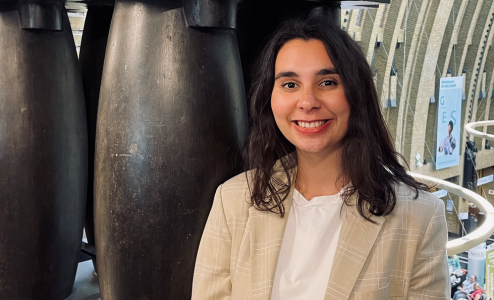
Ellie says, “I believe it will take a lot of time to break down stereotypes to the point where anyone from a minority community is seen as equal.”
So how can economics help with this?
“Economics is one of the most versatile of the sciences because it’s focussed on the individual and the decisions they make daily. You can also connect it to so many other sciences—sociology, political science, psychology.”
Ellie’s specialisation, experimental economics, allows you to simplify constructively for the sake of building a richer, and more accurate, understanding of an economic system. “Putting a number on it” can also help start the conversation with someone who might not respond to other reasons for change.
The change we need, she points out, comes from being more educated about what is going on in the world, but also one’s own biases and how they shape thought. This work of building awareness is key to Ellie’s activism on climate injustice and working conditions in clothing factories.
The emergence of populism and the volatility of many online discussions also means we need to create conditions in which we can explore why we think a particular way.
We need to allow for an environment for others to express their opinions knowing that the other person won’t get mad
Pursuing diversity and inclusion is about “being a decent human being”, knowing that the only way we can go forward is if we each speak up and listen with respect to others.