The University moved into uncertain times during World War II. Campus life was disrupted, especially after the bombings of Pearl Harbor and Darwin in 1942. Requested to produce graduates at an accelerated rate for the war effort, the University needed to reduce or abbreviate its courses.
After 1942, student and staff numbers decreased when men and women enlisted. The campus was ‘huts and trenches’: dotted with corrugated huts for classrooms and blacked out at night due to air raid fears. Sandbags were everywhere, but especially around the Engineering and Commerce buildings, the headquarters for the Ambulance Brigade and Air Raid Precautions. The Royal Australian Air Force (RAAF) and the Women's Auxiliary Australian Air Force (WAAAF) were drilled on sports ovals and occupied the colleges.
A permanent impact was the Commonwealth Government’s legislation establishing the Universities Commission, bringing the University formally into the scope of national policy. It began with regulating enrolments and implementing the Commonwealth Reconstruction Training Scheme (CRTS) for service personnel.
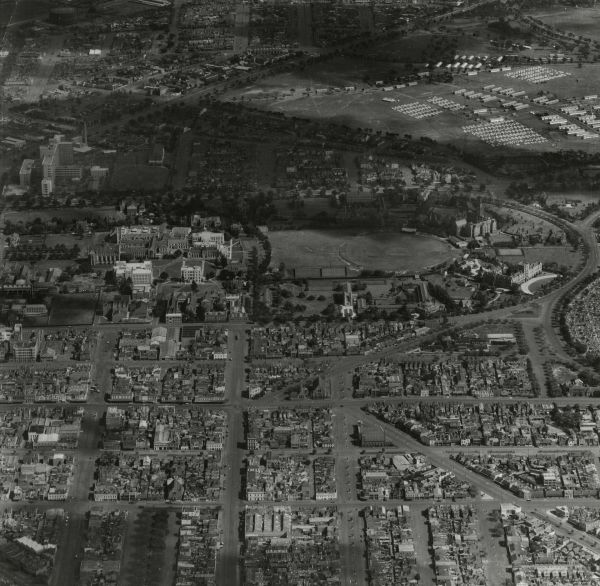
Campus life
Paper restrictions meant writing on both sides of exam papers. Timetables were changed to minimise classes after 6pm because of limited air raid shelters, and lighting restrictions were put in place. Commerce students were affected, as many were part-time and attended evening lectures. Students also faced transport difficulties.
The CRTS funded thousands of scholarships and living allowances for eligible men and women, and increased student numbers. Commerce gained hundreds of students through this scheme, who studied full time, part time or on a single-subject basis. Accommodation was strained, even with the recently opened Commerce building.
The faculty
At the beginning of World War II, the Dean, Sir Douglas Copland, was sent to Canberra as the Commonwealth Prices Commissioner, the most powerful bureaucrat, and equivalent to a senior cabinet minister. The Ritchie Chair was vacated by Lyndhurst Giblin, who had retired, but was then appointed Chair of the powerful Commonwealth Finance and Economic Committee. Lecturers were seconded, including Dick Downing, who assisted Copland in Canberra, and Jean Polglaze, part-time head of the statistical section at the Department of Defence’s Melbourne office.
Tutor Ken Williams joined the RAAF and was sadly killed in action. Donald Cochrane enlisted and returned, becoming the Sydney Myer Chair and later Foundation Dean of Monash’s Faculty of Economics.
First economics graduates in the public service
World War II brought an influx of young economics graduates into the Commonwealth Public Service, which urgently required their expertise in unprecedented times. From the University of Melbourne, they included Frederick Wheeler (BCom) who assisted with mobilisation and secretarial duties to Giblin’s Committee. Afterwards he was a senior public servant and gained a knighthood. Another was Bob Whitlaw (BCom), who became one of the world’s leading authorities on international financial matters, and the first head of the OECD. Lenox Hewitt (BCom) joined them in Treasury and was later awarded a knighthood for his leadership.
The Commonwealth Reconstruction Training Scheme (CRTC)
CRTC recipient Hec Gallagher (BCom) became a teacher and a senior public servant. His book, We Got a Fair Go, praised the CRTC’s idealism for changing participants' lives and benefiting the community.
Examples of the many other beneficiaries were Graham Tucker (BCom), who gained a Cambridge PhD and became Professor of Economic History at ANU, in the School of General Studies. Russell Matthews (BCom Hons) became a professor at Adelaide and ANU, and John Kenley (BCom, MCom, PhD) was a guiding figure in building Australia’s reputation in worldwide accountant standard setting.
Post-war
There was a post-war exuberant mood. The economic boom and the expansionary environment was reflected in Faculty developments.
Commerce had become the Faculty of Economics and Commerce in 1944 with the establishment of the Department of Economics. CRTC students continued their studies until the early 1950s. Gradually there were more full time than part time students. Student numbers were up to 2200 in 1948 compared to 249 in 1943. The Diploma of Commerce was dropped in 1947. By 1950, the student–staff ratio had fallen from 30:1 to 20:1. This was a relief, but the CRTS funds were going too.
Wilfred Prest was appointed to Douglas Copland’s Truby Williams Chair. In 1945, Copland had resigned and left Melbourne University altogether. Professor Wood was the Sidney Myer Chair. The Ritchie Chair was filled by Benjamin Higgins in 1948. In 1954, Alex Fitzgerald was appointed to the G.L. Wood Chair in Accounting, the same year that the University celebrated its centenary.
More stories
-
Indigenous Economic Power Project
In April 2024, the Dilin Duwa Centre for Indigenous Business Leadership, in partnership with Indigenous data custodians and the Australian Bureau of Statistics unveiled groundbreaking findings: Indigenous businesses generate approximately $16 billion in annual revenue.
-
Downtown boardrooms to uptown classrooms: A brief history of the Department of Finance
Recognised as a department only in 2001, the Finance discipline at the University of Melbourne has its roots in Accounting and has evolved from basic business finance lessons into a vital area of academic inquiry, driven by shifting attitudes and the growing demand for expertise in corporate finance.
-
Influence and enrichment: Celebrating FBE contributors
Emeritus Professor Ross William's book 100 Contributors over 100 Years highlights the influential figures who have shaped FBE, showcasing their remarkable contributions to teaching, research, and leadership over the past century.
-
Dilin Duwa Centre for Indigenous Business Leadership
The Dilin Duwa Centre for Indigenous Business Leadership evolved from the successful MURRA program, created by Professor Ian Williamson and Associate Professor Michelle Evans at the Melbourne Business School, aimed at helping Indigenous Australians excel in business.