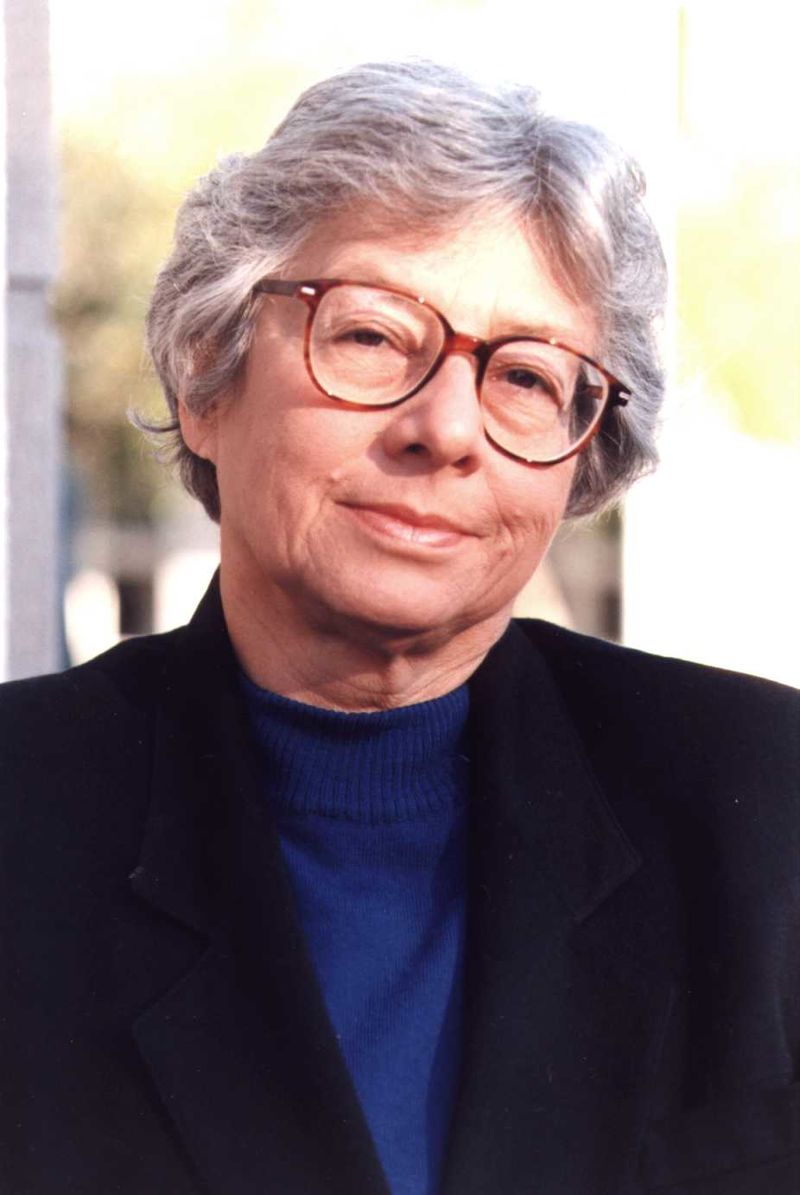
Helen Hughes (1928–2013)
AO BA Hons (1948), MA Hons (1951) PhD LSE (1954 )
Celebrated as ‘Australia’s greatest woman economist’ by the Australian Dictionary of Biography, Helen Hughes had a distinguished career in academia and at the World Bank, shaping national policy well into her eighties.
In 2013, Helen Hughes was heralded as ‘Australia’s greatest woman economist’ by the Australian Dictionary of Biography.
After studying Economics at the University of Melbourne, she was set on her path as a leading economist in academia and at the World Bank. Well-respected as a public intellectual, she continued to work and shape this country well into her eighties.
Prague to Melbourne
Born Helen Gintz to a Jewish family in Prague, Helen escaped with her family just before the Second World War, finding safety in Australia.
An outstanding student as soon as she entered Australian schooling, she left the University of Melbourne, with a BA (Hons) in Economics.
Despite the Commerce faculty being established in 1925, at the time, honours degrees in Economics were technically structured in the Faculty of Arts.
For her MA(Hons) 1951, her thesis examined the development of the steel industry, and was published by Melbourne University Press in 1964.
Despite her diligent and successful study, as a woman, Hughes felt she needed to complete PhD to be taken seriously.
‘I wanted to go further than teaching in schools and writing for women’s pages. I wanted to be an economist,’ she told the Journal of the Asia Pacific Economy in 2007.
Helen’s PhD expanded on her MA by analysing the impact of technological change on labour in the iron and steel industries of Great Britain, Germany, and the US in the 1920s and 1930s.
Working Life
Despite Helen’s academic success, she felt that the culture of the University at the time made it near impossible for married women or mothers to find work at Melbourne. Instead, she moved into a role as a business economist.
Between 1959 and 1969, she held a number of lecturing positions, including a five-year stint in the Research School of Pacific Studies at ANU. Here began a life-long commitment, and she was one of first to predict the rise of Asian-Pacific countries that transformed the study of East Asian economics.
In 1969, Helen became the first woman and the first Australian to be appointed to management at the World Bank. As an applied economist, she found this ‘fantastic’, and held various roles, establishing a legacy specialising in what are known today as the World Development Indicators.
Returning Home
Upon returning to ANU, Helen was on a mission to create the university’s first graduate school. From 1983 to 1993 she was professor of Economics and Executive Director, of the National Centre for Development Studies, which became a key component of the Crawford School. Today the Crawford School of Public Policy stands as a reminder of Helen’s pioneering efforts and her innovation.
In 1983, Australia’s Foreign Minister, and Hughes’ former student, Bill Hayden appointed her as the deputy chair of the Jackson Committee, reporting on foreign aid for the Australian government. Over the coming years, she’d gain nation-wide recognition as a public intellectual and was one of few women with an international reputation as an economist.
In 1987, she was appointed as a member of the United Nations Committee for Development Planning.
Her own version of retirement
After she ‘retired’ in 1994, Helen continued at the Crawford School for 15 years. Returning to Melbourne from 1994-1995 as a professorial fellow at the University of Melbourne, she directed a full employment project at the Melbourne Institute of Applied Economic and Social Research.
For over 40 years Helen Hughes wrote, edited and co-authored scores of books and articles on employment, economic development, international trade and investment, migration, global policy and Indigenous rights.
Her final book Lands of Shame (2007) was concerned with Aboriginal and Torres Strait Islander homelands. True to form she had presented a controversial perspective, upsetting many while gaining new supporters.
Among many honours, she is a Fellow of the Academy of the Social Sciences in Australia, an Officer of the Order of Australia (AO), an honorary Doctor of Letters at La Trobe University, a distinguished fellow at the Economic Society of Australia, and a 2001 Centenary medallist.
In commemorating Helen Hughes’ death in 2013, then-Prime Minister Tony Abbott described her as a “great Australian” and “a force of nature.”
More stories
-
Dylan Alcott
Dylan Alcott is a celebrated athlete, entrepreneur, and advocate for disability rights.
-
Michael ‘Thunderbird’ Tan
For over thirty years, Michael Tan brightened the Faculty of Business and Economics with his infectious joy and dedication as an office porter, where he became a cherished member of the team, known for his friendly demeanor, lively conversations, and unwavering commitment to the university community.
-
Rachel Teo
Rachel Teo, co-founder of Singapore's not-for-profit The Private Museum, passionately believes in the transformative power of art when shared with the community, drawing on her Melbourne roots and family legacy in the arts to cultivate a vibrant cultural scene.
-
Jean Blackburn (1919–2001) and Peter Karmel (1922–2008)
Graduates in Economics, Peter Karmel and Jean Blackburn significantly influenced educational policy in Australia, with Karmel's 1973 report exposing social inequalities in education and Blackburn's pivotal research shaping the future of girls' education in Victoria.