Simon Griffiths
BE, BCom (2007)
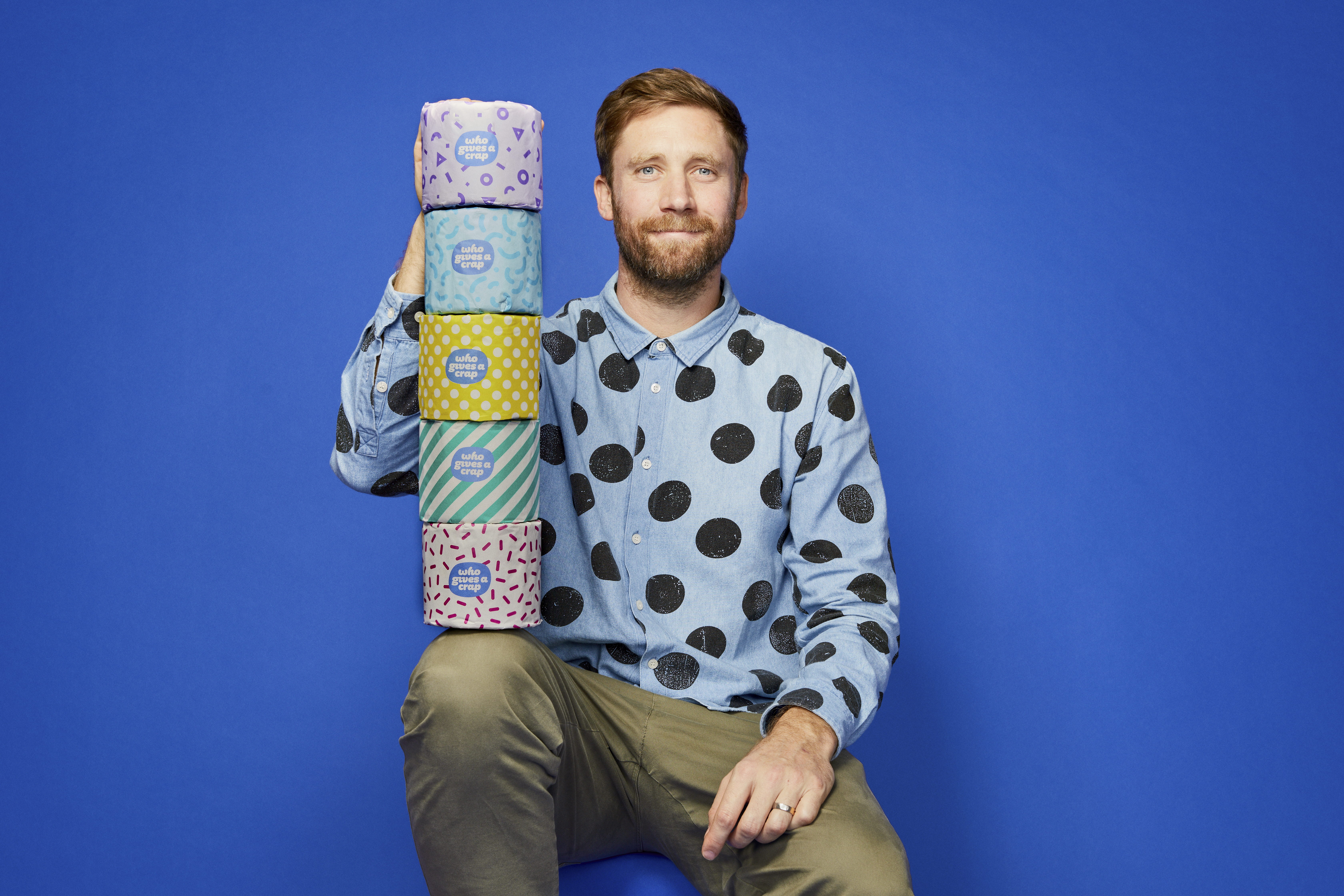
Social entrepreneur Simon Griffiths, co-founder of the eco-friendly toilet paper brand Who Gives a Crap, has created impactful, socially-conscious ventures that inspire others in the industry to embrace a profit-for-good model.
Social entrepreneur Simon Griffiths, co-founder of eco-friendly toilet paper Who Gives a Crap, is a keen surfer both at the beach and in the boardroom. From viral marketing to subscription models, Griffiths has jumped on emerging waves of consumer behaviour at the right time, using his economic understanding to read when an idea is at its biggest potential. Part of that, he says, comes from a love of chaos.
“I just love those environments where you're seeing something unfold that you may never get the opportunity to see again. That's what a brilliant start-up idea is about,” he says.
“You find product market fit that's so strong the product can take off at a an astronomical pace.”
Early days
Prior to co-founding Who Gives a Crap, Griffiths graduated with bachelors degrees in Commerce and Engineering at the University of Melbourne. Following graduation, he help started Ripple, an internet advertising model that donated to charity. This philosophy continued with Shebeen, a socially minded bar that aimed to donate to charity with every drink.
Without many similar business models to draw inspiration from, Griffiths says that a lot of the organisation of Shebeen and Ripple involved making things up on the go. While neither project proved to be viable in the long term, they taught him valuable lessons that he takes into his ventures today.
A roll in every bathroom
When they started Who Gives a Crap in 2012, Griffiths and his co-founders Jehan Ratnatunga and Danny Alexander knew from experience that it would be best to find a consumer base before starting production. They set out to crowdfund through IndieGoGo, and Griffiths pledged to sit on a toilet in a warehouse until the tally reached $50,000.
“Our whole business is actually built on jumping in and riding waves at the right times,” he says.
“There's this great saying that the surfer that catches the wave is the one that's in the water.”
They’d chosen their waves wisely. Who Gives a Crap were one of the first businesses to reach success through crowdfunding, and Griffiths’s stint on the toilet gained them a huge audience in the earliest days of internet virality, shortly after Facebook had introduced the 'Share' button. Who Gives a Crap toilet paper now sits in bathrooms across Australia and much of the world. This year, they’ve made their second ever multi-million-dollar donation, taking their total past $15 million. As the reach and the impact of the business grows, Griffiths keeps his focus on the ‘profit-for-good’ model that he and his colleagues have honed.
“We would sacrifice some donation this year, if it helps us [grow the business] to donate more overall in the long run.”
Capitalising on excitement
Griffiths’s fascination with economics and the chaotic world has helped to train his business sense. Whether a business was selling beers or toilet paper, Griffiths saw an untapped desire for the consumer to have an emotional investment in the product they’re buying. Simply, it’s in the best interest of Griffiths, Who Gives a Crap, and their consumers if everyone in the process is excited about the impact the business is making. It’s the core of Griffiths’s business philosophy, while also conveniently being good marketing.
“Making people understand, believe, get excited by and want to tell other people about the product - I think that's the holy grail,” he says.
“You can start to play with people's decision making, which is all microeconomics, and how they place value on the goods and services that they purchase.”
“Bringing all of that together, combining the economics and the social impact and getting it into that moment where it's ready to explode. That's what I live for.”
A beacon for change
Fundamentally, Griffiths sees Who Gives a Crap as an opportunity to show other businesses that it’s possible to actively make change.
“I think we've got an opportunity to shape, not just the toilet paper category, but capitalism more broadly, if we get this right,” he says.
Hopefully that means that lots of other companies will come along, and we can be a lighthouse to allow people to follow in our footsteps.
More stories
-
Dick Downing (1915–1975)
Professor Richard ‘Dick’ Downing, a renowned social reformer and economist, shaped national economic policy debates through decades of impactful work in academia, leaving a lasting legacy in Australia’s economic landscape.
-
Jean Blackburn (1919–2001) and Peter Karmel (1922–2008)
Graduates in Economics, Peter Karmel and Jean Blackburn significantly influenced educational policy in Australia, with Karmel's 1973 report exposing social inequalities in education and Blackburn's pivotal research shaping the future of girls' education in Victoria.
-
Sir Douglas Copland (1894–1971)
Sir Douglas Copland, the Foundation Dean of the Faculty of Commerce at the University of Melbourne, was an influential figure in academia, government, and international diplomacy, renowned for his role in shaping Australia's economic landscape, particularly during WWII.
-
Betty Lawson (1920–2008) and Shirley Horne (1921–2007)
Shirley Horne and Betty Lawson faced career discrimination in public service, but they became community activists, leading the charge for equal pay and gender equity through their involvement in feminist and union organisations.