Elizabeth Muriel ‘Betty’ Lawson (1920–2008)
Dip Com (1944), BCom (1967)
Betty Lawson is revered as one of Victoria’s leading advocates for teachers in the state. A commerce student, schoolteacher and later principal in an era when she was expected to forgo it all for motherhood, she continued to fight for the working rights of those just like her.
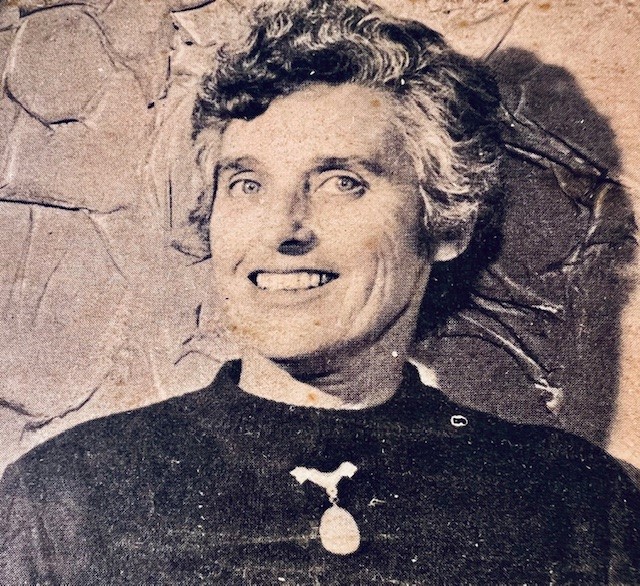
In 1930s-era Melbourne, when Betty Lawson (nee Bennett, later Stevenson) was growing up, it was significant that she finished high school, let alone that she had ambitions to go to university. Lawson’s father felt that it was a waste of time, but she defied these expectations and took up a teaching studentship instead. Completing her teaching certificate, she then started a commerce degree at the University of Melbourne.
Classmate June Mayson recalls that Lawson was seen as a leader on campus and often motivated others with an “engaging turn of phrase.”
Ignoring the naysayers
Lawson married in 1942, and as married women could not have studentships, was forced to leave full-time university studies. She returned to work as a teacher, but was also not allowed to teach full-time, restricted by the attitudes of the day. Undeterred, she studied part-time while working part-time as a teacher, and gained a Diploma of Commerce in 1944.
In 1956, Lawson watched The Temporary Teachers Club and the Victorian Teachers Union (VTU) fight for the change that allowed her to teach full-time. She earned her Bachelor of Commerce in 1967, having studied part-time while teaching full-time and raising three children. In the 1960s, Lawson’s union activities increased. She made equal pay campaigning a priority and represented women on the VTU executive.
Leadership in the face of adversity
Thriving in union work, she became the first woman elected as president of the Technical Teachers Association of Australia (TTAA) in 1966/67. Lawson’s influential leadership, charm, eloquence, and political nous gained both her and the Association considerable media attention as the push for equal pay continued.
Locally, the quest for equal pay had reached a stalemate in 1967. Lawson believed that media focus had led to Queensland’s teachers winning equal pay before their colleagues in Victoria. Representing the Technical Teachers Union of Victoria, Lawson joined with VTU president Hilma Cranley and other community leaders to build political momentum, organising the ‘Talk Out Equality for Women’ conference.
Public pressure, as Lawson predicted, embarrassed the government. The threat of strikes over equal pay just before Christmas was the final straw, and the government met Lawson and the Union’s demands. Through this process, Lawson’s leadership gained momentum and diversified. After being elected in 1968 as the first female president of the newly formed Technical Teachers Association of Victoria (TTAV), Betty led a delegation to the Minister for Education, seeking superannuation rights for married women teachers. Equality in this area was not achieved until 1982, when it became compulsory for all women public servants.

A principal with principles
Betty still held goals in education, and her determination to lead a school saw the principal positions advertised 'for men or women' for the first time in 1970.
That year, she was appointed as head of Sunshine North Technical, the first woman in charge of a co-educational technical school. Betty’s arrival changed attitudes – she even dared to wear long pants, when previously women wearing them were sent home to get changed.
Her position as principal was more than structural – in very practical ways she encouraged women to study and seek promotion. While in charge, she developed programs to broaden students’ horizons about subject and career choices both at Sunshine and later as principal of Box Hill Girls’ Technical College.
Remembering Betty’s influence
International Women’s Year (IWD) in 1975 was also the final year of Betty’s teaching career. At the teaching industry’s IWD seminar, women from across the sector celebrated Betty and her leadership in women’s employment and girls’ education. Recognising her influence, premier Rupert Hamer invited her to be a member of the Victorian Government’s Equal Opportunity in Schools Committee.
Despite Betty’s milestones, it would be almost twenty years before the TTUV elected its second women president. Following her appointment as principal in 1970, only a handful of women would hold the same role in the decades that followed.
Victoria’s first female premier, Joan Kirner, worked on industrial relations issues with Betty in the 60s. For Kirner, Betty was a role model.
She inspired me, and I could see what was possible for women.
In 2003, Betty Lawson was inducted into the honour roll of the Victorian Government’s Women’s Register, in recognition for her trailblazing leadership in the community and her contribution to teaching in Victoria.
Betty Lawson died in 2008, and is still remembered as a fierce advocate and dedicated educator.
More stories
-
James ‘Jim’ Cairns (1914–2003)
James 'Jim' Cairns, a former policeman turned politician, is best known for his leadership in the 1970s anti-war moratoriums and his role as Treasurer and Deputy Prime Minister in the Whitlam government.
-
Blayney Morgan
Blayney Morgan, the third generation of his family to study at the University of Melbourne, has forged a distinct career in auditing and financial leadership.
-
Laura Foo
Laura Foo, the 2023 winner of The Great Australian Bake Off, is a passionate baker whose journey flourished during the pandemic. She's since built a successful brand, LozFoz Bakes.
-
Daniel Moorfield
In 2023, Daniel Moorfield transitioned from a successful 25-year career in executive roles to become the CEO of SecondBite, a not-for-profit organisation dedicated to rescuing food and combating hunger.