The hardest part of building a startup isn't always the idea. It's everything that comes after.
That's one of my biggest lessons after spending three weeks working with two startups through two of my faculty programs during the winter break: Virtual Industry Projects and Business Innovation Challenge.
Across both programs, I worked with two startups, two founders, and two distinct challenges. While one focused on identifying funding pathways and the other explored responsible AI innovation, both revealed the same reality of building a business: progress rarely comes from having all the answers, but from learning how to make decisions, adapt and keep moving forward.
Two programs and projects
Virtual Industry Projects connect students with real industry clients to solve business challenges over two weeks. My team worked with a pet industry startup to explore more than 20 funding opportunities across grants, debt financing and venture capital.
At first, the task seemed simple: find potential sources of funding. However, the deeper we went into our research, the more we realised the challenge was not finding opportunities, but understanding which ones were valuable for the business.
Through our research, we developed a funding database and report that recommended opportunities based on the startup’s circumstances. The process gave me a greater appreciation of the decisions founders encounter before reaching their first customer.
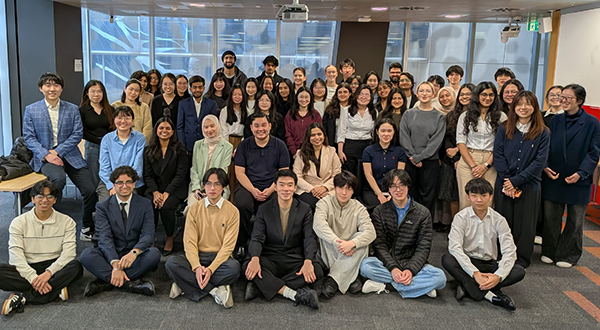
The Business Innovation Challenge offered a completely different experience. In just two days on campus, my team worked with Launchpanion, an Australian startup that aims to make entrepreneurship more accessible for first-time founders aged 16 to 24 years.
Our challenge was to design and pitch an AI-powered launch strategy, while considering the governance and safeguards needed for responsible implementation. With limited time, we moved quickly between understanding the problem, testing ideas and refining our solution. Through the experience, I saw how AI can support early-stage businesses, from customer research and content creation to product development.
Although the projects were completely different, they shared a common theme: startups are built on shifting ground. Whether evaluating funding opportunities or exploring the responsible use of AI, we had to challenge our assumptions, consider different possibilities and decide on the best path forward.
Before these experiences, I often thought the hardest part of a startup was having a strong idea, but I learnt that bringing that idea to life is where the real challenge begins; from securing funding and making decisions to balancing ambition and knowing when to adapt. What challenged me most was learning to be comfortable without all the answers and turning research into something founders can use.
Reflections and lessons I’ll carry forward
Looking back, I didn’t realise how much I'd learnt until the experience was over. One minute, you're brainstorming solutions with people you've only just met, and the next, you're pitching an idea you've just developed. You're being challenged in different ways throughout the process, but that's where the growth happens.
It’s also never too early or too late to get involved. You don't need to be the most experienced person in the room or have all the answers before you start. Curiosity, a willingness to learn, and putting in the effort will take you much further than having perfect responses.
My biggest advice would be to give it a go, even if you don't feel completely ready. Have an open mind, be willing to learn, and don't put too much pressure on yourself to win. For me, the biggest takeaway wasn't just learning how to solve a business problem. It was learning how to think differently, collaborate with people from different backgrounds, and communicate ideas under pressure. Those are the skills that stay with you well beyond the challenge itself.
A huge thank you to the Faculty of Business and Economics for providing these immersive industry experiences and challenging us to think differently, embrace uncertainty, and reflect along the way.
If you’re a Faculty of Business and Economics student interested in taking an industry program, see our full list of co-curricular programs: BCom students | MBS students