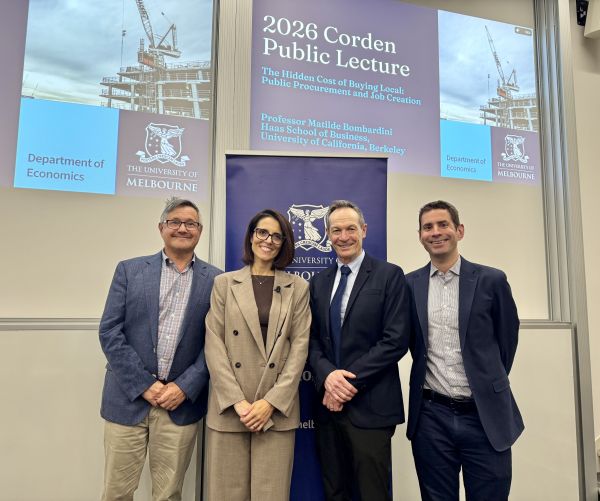
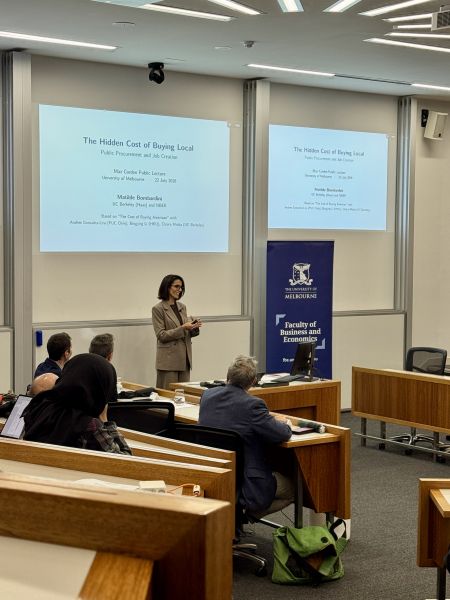
The University of Melbourne welcomed Professor Matilde Bombardini from the Haas School of Business at the University of California, Berkeley, to deliver the 2026 Corden Public Lecture on Wednesday 22 July 2026.
Public procurement, government spending on goods, services, and infrastructure, accounts for roughly 10–15% of GDP in most advanced economies and represents one of the most powerful levers of industrial policy available to governments. Many countries have adopted domestic content requirements and 'buy local' preferences in their procurement rules, from the Buy American Act in the United States to Local Jobs First programs in Australia and equivalent schemes across Europe. This lecture reviews the economic evidence on the consequences of such policies for employment, wages, and taxpayer costs. The findings raise important questions about whether procurement is an efficient tool for job creation and industrial policy.
About the speaker
Professor Matilde Bombardini holds the Oliver E. and Dolores Williamson Chair in the Economics of Organization and is a professor of Business and Public Policy at the Haas School of Business, UC Berkeley. She is also a Fellow in the Institutions, Organizations and Growth Program, a Research Associate at the National Bureau of Economic Research (NBER) and the Centre for Economic Policy Research (CEPR), and Co-Editor of the Journal of International Economics. She obtained her PhD from the Massachusetts Institute of Technology in 2005.
Her research focuses on the organisation of interest groups, lobbying, and the link between corporate philanthropy and firms’ political engagement. Her work in international trade has focused on the links between a country’s skill distribution and comparative advantage.
About the lecture series
The Corden Public Lecture Series is named after Emeritus Professor Max Corden, one of Australia’s most famous economists.
Professor Corden contributed to the field of economics through his work and his long and extensive teaching career, during which he shaped the thinking of many of today’s great economists. He is known for his work on the theory of trade protection, including the development of the Dutch disease model of international trade. He has also been active in the fields of international monetary systems, macroeconomic policies of developing countries and Australian economics.
Learn more about previous lectures
More stories
-
Turning luck into pluck: Positioning Australia for an uncertain future
-
Roots of Extremism – Social Dynamics and the Long Shadows of History in the Rise of the Nazi Party
-
This is how the 1970s oil shock played out. There are lessons for the economy today
-
Melbourne Institute expects RBA to increase rates in May, but should consider holding