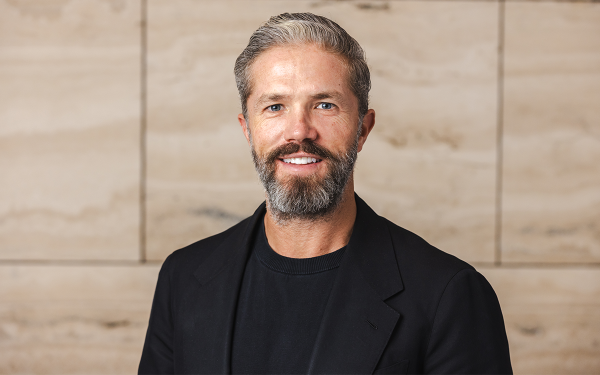
Andrew Cramer – Chief Financial Officer at REA Group
Bachelor of Commerce (Honours) and Bachelor of Laws (Honours)
Tell us about your career journey since completing the honours program.
The honours program gave me the confidence and educational foundation to successfully apply for investment banking internships. Following the completion of my studies, I accepted an offer to join Macquarie. While my studies were important to me, I also wanted to fulfil another personal goal before beginning my career, so I spent nine months backpacking around the world with my best friend, who is now my wife.
I spent the first four years of my career at Macquarie before moving to Citi, where I helped establish its Technology, Media and Telecommunications (TMT) Investment Banking coverage team. During that time, two of my key clients were News Corp and REA Group.
After eight years at Citi, I was presented with an incredible career opportunity and invited to relocate to New York City to join News Corp as Deputy Chief Financial Officer. Over the next seven years, I worked hard to deepen my experience and broaden my knowledge, which ultimately led to my appointment as Chief Financial Officer of REA Group back home in Melbourne. REA Group is controlled by News Corp and listed on the Australian Securities Exchange (ASX).
Reflecting on your experience in the honours program, what were some of the aspects of the program that you found valuable?
The skills I developed through the core finance subjects and the thesis process have proven invaluable throughout my career. They helped me build deep expertise in corporate finance and gave me the confidence to become a subject matter expert in the field.
The network of like-minded peers was also incredibly valuable. Without some of their insights and influence, I may never have pursued a career in investment banking.
Perhaps most importantly, successfully gaining entry into the honours program and performing well gave me a strong sense of confidence and achievement. That confidence has stayed with me throughout my career and motivated me to embrace new challenges and opportunities as they arose.
You previously worked as Deputy CFO of News Corp in New York and are now CFO of REA Group. What role did honours play in helping you achieve this, particularly given the interest many students have in working overseas?
My honours degree opened the door to investment banking, which in turn created opportunities to work internationally. Similar career paths, including consulting, Big Four transaction services and related fields, can also provide pathways to overseas opportunities.
Working abroad opened doors that I would never otherwise have encountered and gave me invaluable professional and personal experience. Because of this, I later helped several team members at Macquarie and Citi secure opportunities to work in New York during my time at News Corp.
These types of organisations also provide opportunities to build relationships with senior leaders and gain exposure to high-level decision-making. I embraced those opportunities throughout my career, and they ultimately helped lead me to senior leadership roles at News Corp and now REA Group.
Honours degrees at the university come with a thesis. Can you share what you wrote, and if you think it helped in your professional career?
My thesis examined whether venture capital-backed Initial Public Offerings (IPOs) outperformed non-venture capital-backed IPOs. Aside from finding and pursuing an interesting topic, the real magic was in the process and hard work throughout the journey of completing my thesis.
One of the greatest challenges was identifying a research topic that would contribute to existing literature while also aligning with my own interests. For me, that was perhaps the most difficult part of the entire process.
I was fortunate to have an exceptional supervisor who challenged and supported me throughout the year. His guidance played an important role in helping me develop both the thesis and my broader analytical skills.
The hard work paid off, and I was awarded First Class Honours for my thesis. It remains one of the most satisfying accomplishments of my academic journey.
Can you share something you struggled with in your honours degree, and how did you overcome it?
At various points throughout the year, the workload and complexity of the course material felt overwhelming, particularly around major assignments and exam periods.
I was fortunate to have a close-knit group of four or five like-minded friends who supported one another through those challenges. We regularly met to discuss difficult concepts, worked together on group assignments and, most importantly, encouraged each other during the more stressful periods of the year.
We all remain in contact today, and the friendships we formed were strengthened through the shared challenges and experiences of the honours program.
Lastly, is there any advice you would give to students aiming to get into honours?
Honours is an incredibly rewarding year. It gives you the opportunity to deepen your knowledge, prepare yourself for a career in your chosen field, and open doors to opportunities that may not otherwise be available. It also allows you to build lasting friendships and professional relationships.
Most importantly, successfully completing honours leaves you with a strong sense of confidence in your own abilities. You come away knowing that you can overcome challenges, solve complex problems and achieve ambitious goals if you are willing to put in the work.
The magic is in the work.