Impactful, challenging, and transformative. As part of the Global Voices Fellowship program, attending the “AI for Good” Global Summit in Geneva provided valuable insight into the increasingly ubiquitous topic of Artificial Intelligence (AI) and the development of policies designed to regulate it.
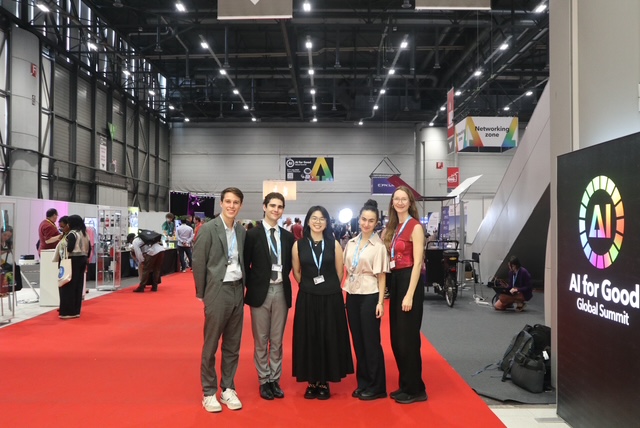
Attending the “AI for Good” Global Summit in Geneva was an incredible opportunity to explore the world of Artificial Intelligence (AI) policy. Most importantly, I learnt that this space is riddled with vague terminology that makes it difficult for non-experts to participate meaningfully in the conversation.
Seeking new learnings in public policy
As part of the Global Voices Fellowship program, I had the privilege of attending the “AI for Good” Global Summit in Geneva earlier this year. This experience gave me valuable insight into the increasingly ubiquitous topic of AI and the development of policies designed to regulate it.
Coming from a Bachelor of Commerce with minimal technical knowledge, I wasn’t sure what to expect from an AI-focussed program. However, studying economics has fostered a keen interest in public policy and this Fellowship seemed like an intriguing opportunity to learn about how policy is discussed and formed in a multilateral forum.
The application process was demanding – especially without any prior experience in policy writing. A core insight for anyone considering the Fellowship is to establish a specific objective, the more niche the better. I focussed on systemic economic risks associated with the use of AI-driven algorithms in financial markets. Identifying this very particular application of AI allowed me to align the topic with my interests in finance and economics. Unpacking such a sharply defined angle also gave me the confidence to speak with authority on this topic and make a meaningful contribution in a field as broad as AI.
De-coding AI definitions and legal frameworks
Discovering how little legislative progress had been made in this area was surprising, especially given the noise AI headlines generate in the media. As I undertook more research, I became increasingly convinced of the risks that need to be addressed and increasingly impassioned by how slowly policy was progressing. It was this sense of urgency and a belief that I could help shift the status quo of AI regulation, that motivated me throughout my preparations for the conference.
The learning curve of the scholarship is a steep one. It requires lateral and independent thinking in an environment filled with dense, technical jargon. Global Voices provided significant support and the process of developing my policy recommendation taught me to clearly articulate my points, defend my ideas, and ask questions with precision when there was something I didn’t understand. This skill is particularly crucial for young people entering spaces filled with more experienced voices. Although I was initially daunted by engaging with experts, it was from critically questioning what had been said that I gained the most valuable insights.
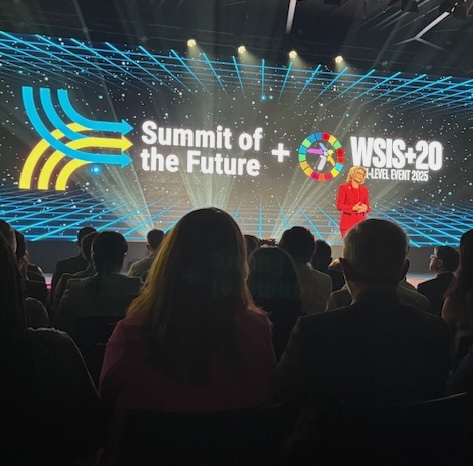
Participating in the conversation led to new insights
The Summit itself was nothing short of transformative. It challenged me intellectually and reshaped how I think about multilateral diplomacy, particularly in relation to the politicisation of science and the number of philosophical considerations at the heart of AI. I also had the rare opportunity to speak to a room of educators about navigating the AI transition as a student. It was an empowering experience to speak for the oft-cited youth, who are often invoked rhetorically without usually being present in the conversation.
The Fellowship reinforced that you don’t need a technical background or decades of experience to ask legitimate questions or raise valid concerns. The complexity of the technology makes terms like “responsible AI” and “ethical AI” convenient, yet these often lack clear meaning. Such simplification becomes risky when labels are used ambiguously as a synecdoche for AI risks at large. As technology continues to advance dramatically, I believe that the most valuable tool will become our ability to translate between formal algorithmic specifications, legislative frameworks, and human intuition. This skill extends beyond AI policy; precise communication is a real advantage in a professional landscape saturated with buzzwords. I am also optimistic about the number of incredibly intelligent people working on nuanced definitions that will support effective governance without relying on unnecessary jargon.
Recommending the Fellowship
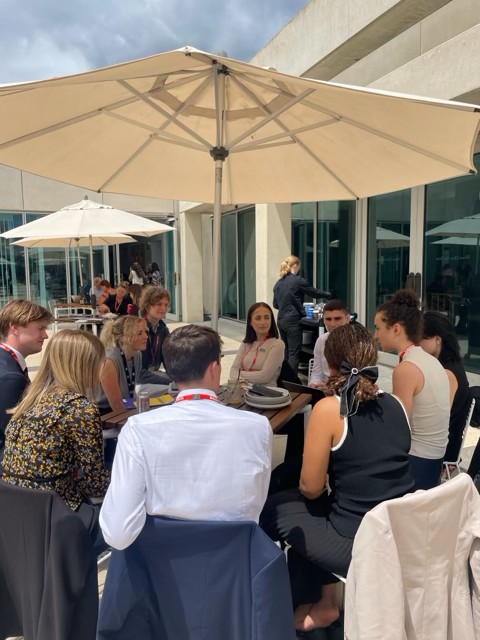
Overall, I would really recommend the Global Voices Fellowship to anyone interested in international affairs and public policy. I would also extend that recommendation to anyone with a willingness to listen, question, and challenge the world around them, especially as it evolves so rapidly that sometimes we sometimes forget we can have a voice in shaping it. Thank you to Global Voices, the Faculty of Business and Economics at the University of Melbourne, and my fellow delegates for making this experience possible. The opportunity to be invited into the conversation alongside so many inspiring individuals was a deeply impactful experience and truly such an honour.