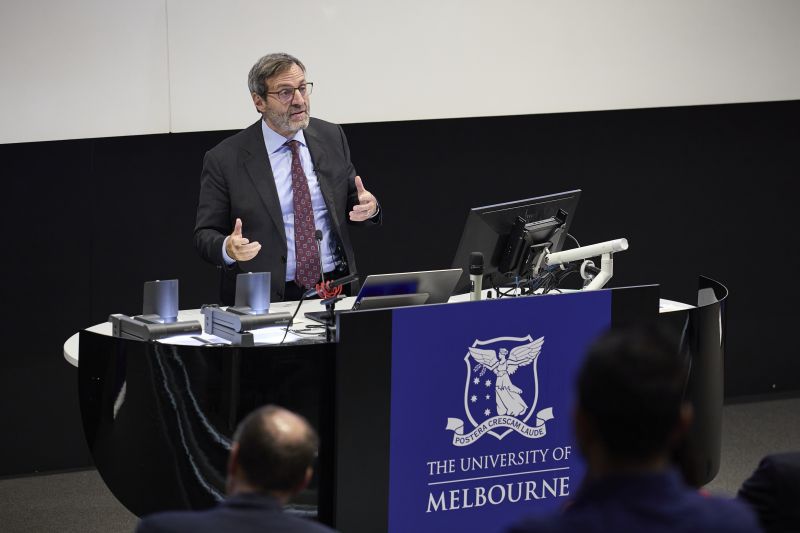
The University of Melbourne hosted Professor Giancarlo Corsetti to present the 2025 Finch Public Lecture, on Tuesday 28 October 2025. The lecture explored the significant shifts in global economic policies, the fragmentation of market power, and the impacts of global interconnectedness and the effect on the future of the world’s economy.
Fragmentation of market power
The geopolitically driven trade fragmentation, and the power-based restructuring of international relations now coexist with largely resilient capital mobility, raising questions about the stability of this asymmetric regime over the foreseeable future.
Professor Giancarlo Corsetti examined the rise of market power in global trade, showing with cross-country data on firm-level trade flows, the high degree of concentration in export markets. Professor Corsetti warned that this could lead to reduced competition and innovation that could impact societal welfare. "The concentration of market power is one of the possible very likely effects of this trade fragmentation," he stated, emphasising the potential threat to democratic societies and global progress.
Preliminary results from a calibrated global model with production linkages suggest that the social costs of trade fragmentation may be substantial, reflecting changes in price-cost markups shifts and the market entry and exit of large firms.
Global interconnectedness
Despite the rising trend of economic nationalism, Corsetti highlighted the importance of maintaining global interconnectedness. He argued that the world’s economy requires a collaborative solution to address our shared challenges. In an ideal future state, nations would work together to foster productive competition and innovation, rather than pursuing isolationist policies.
The future for a prosperous economy
Professor Corsetti perspective on the current state of global economy, urged policy makes and academics alike to consider the long-term implications of trade fragmentation and market concentration.
He reminded us that through collaboration, we can foster a stable and prosperous global economic future.
About the speaker
Professor Giancarlo Corsetti
Professor of Economics, joint chair Department of Economics and Robert Schuman Centre for Advanced Studies
European University Institute
Professor Giancarlo Corsetti (Ph.D. Yale, 1992), Fellow of the British Academy, is Pierre Werner Chair and Professor of Economics at the European University Institute, and associate professor in the Janeway Institute in Cambridge. He moved to the EUI from Cambridge University in 2022, where he was Professor of Macroeconomics, fellow of Clare College and of the Cambridge INET Institute. He has previously taught at the Universities of Rome III, Yale and Bologna.
Professor Corsetti is a leading scholar in international economics and open macro with pioneering contributions on currency, financial and sovereign crises, monetary and fiscal policy in open economy, and the international transmission and global imbalances. He published extensively in leading journals, such as the American Economic Review, the Journal of European Economic Association, the Journal of Monetary Economics, the Quarterly Journal of Economics, and the Review of Economic Studies and served as co-editor of the Journal of International Economics.
Professor Corsetti is a consultant at the European Central Bank, a regular visiting professor in central banks and international institutions, and a member of the United Nations High-level Advisory Board on Economic and Social Affairs. He is a research fellow of the Centre for Economic Policy Research CEPR, where he serves as coordinator of the Research and Policy Network (RPN) “European Macroeconomic Policy”. He is a member the European Economic Association, where he served as a member of the council, and Program Chairman of the 2007 Annual Congress in Budapest.
About the lecture series
The Finch Lecture is named after Dr David Finch (BCom 1944, BA (Hons) 1945, DCom 2002), a distinguished alum of the University of Melbourne, and a PhD recipient from the London School of Economics, where his supervisor was Lionel Robbins.
He was appointed to the newly established International Monetary Fund (IMF) in Washington, D.C., where he held the position of Councillor and Director of the Exchange and Trade section of the IMF. Among his many achievements, he led the IMF consultation mission to Britain in 1976. Dr Finch retired in 1987 from his position as Counsellor and Head of the Exchange and Trade Relations Department.
The lecture focuses on evolving practices and principles and related issues pertaining to international monetary, financial, fiscal and trade integration and cooperation.