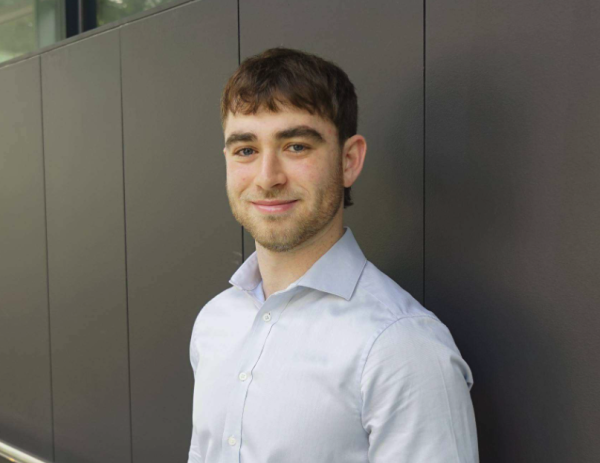
From curiosity about headlines to mechatronics engineering, Jaime Orelowitz reflects on how the Bachelor of Commerce shaped a career trajectory beyond traditional commerce.
Growing up, Jaime Orelowitz would hear people talking about interest rates or economic policy, and wanted a genuine understanding of how the different parts of the economy actually interacted.
"These ideas appear constantly in the news, but I wanted to understand the mechanics behind them," he says.
That question brought him to the Bachelor of Commerce at the University of Melbourne.
The degree gave Jaime more than technical training. It built a durable way of thinking about problems.
"Much like engineering, it trained me to focus on how problems are framed before jumping to solutions."
While he initially gravitated toward the more quantitative subjects, it was Behavioural Economics that left the deepest impression.
"Those subjects highlighted the gap between clean mathematical models and how people and systems actually behave in the real world. They reinforced the idea that real-world decision-making involves nuance, uncertainty, and imperfect information, and learning to work within those constraints has strongly influenced how I approach problems today."
Academically, Jaime achieved Dean's Honours and credits a small group of driven friends for much of his consistency and enjoyment.
"Studying together made the process both more effective and more enjoyable. It became a shared effort rather than an isolated one."
An exchange to University College London broadened his perspective further. Studying alongside students from vastly different academic backgrounds, many combining disciplines, challenged his assumptions about what a typical pathway into business looks like.
"It reinforced the idea that university is less about training for a specific role and more about learning how to think and solve problems using different lenses."
The degree's flexibility also proved formative. Jaime used it to explore whether a traditional finance career was the right fit, gaining experience in an investment setting that ultimately clarified he was more motivated by solving broader, real-world problems.
That clarity, combined with the ability to take engineering subjects alongside his Commerce studies, opened the door to a Master of Mechatronics Engineering.
"At its core, Commerce trains you to work with imperfect information, think in systems, and make structured decisions under uncertainty. Those skills translate well beyond traditional corporate roles."
His advice to current students is to treat the degree as something to actively use, not just complete.
"The greatest value of the BCom comes from applying what you're learning. Get involved, whether that's clubs, case competitions, social events, internships, or innovation programs. The University has a broad range of pathways to explore, including the entrepreneurial ecosystem through the Melbourne Entrepreneurial Centre. University is one of the few environments where curiosity is genuinely encouraged, so take initiative and lean into it.”